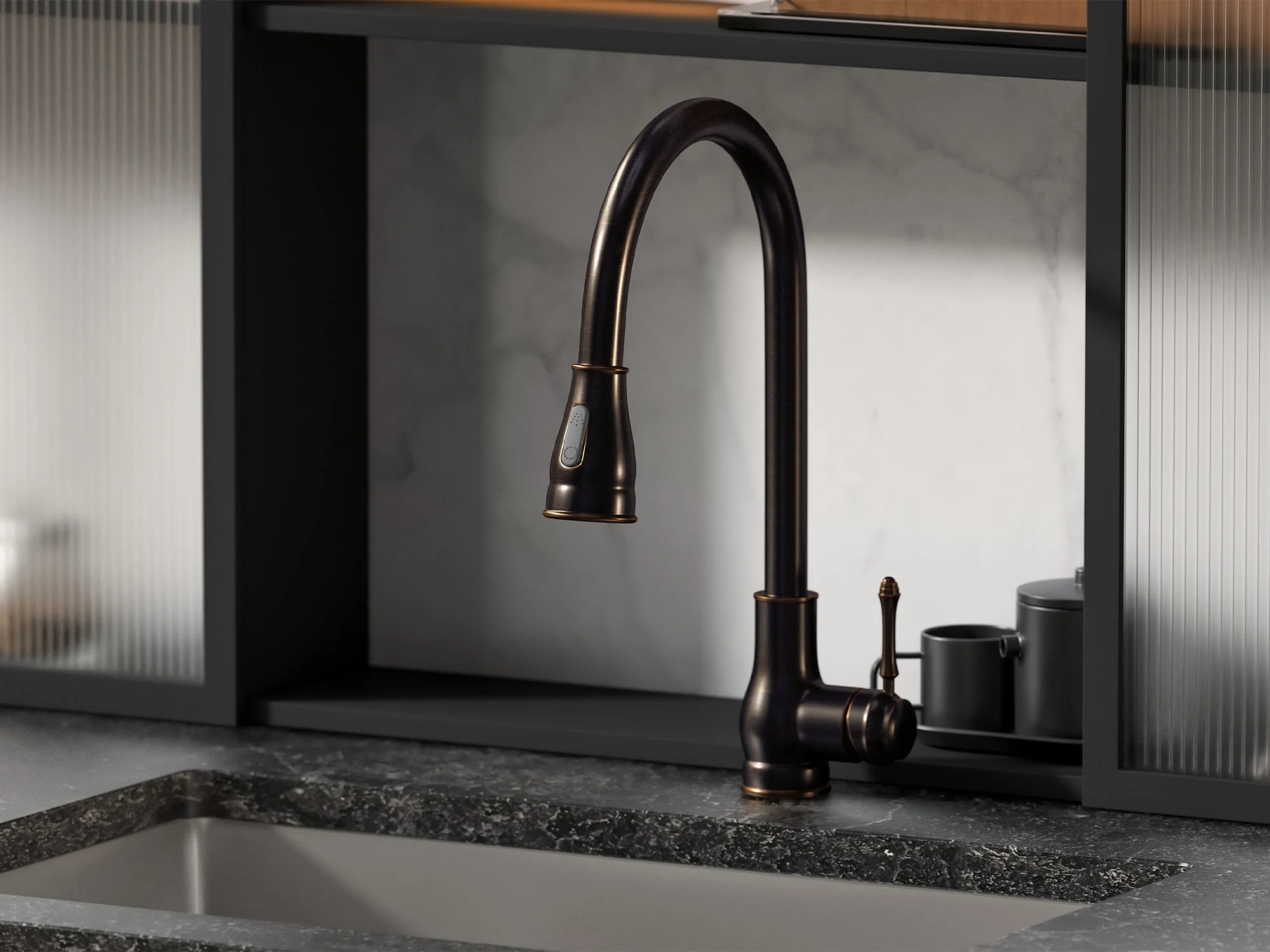
A kitchen faucet is one of the fixtures you may use dozens of times every day. Choosing one based only on appearance can leave you with a faucet that does not fit the sink, does not clear the backsplash, does not reach the useful part of the bowl, or simply feels uncomfortable during everyday use.
The best kitchen faucet is the one that fits your sink and countertop, matches your available clearance, and supports the way you wash dishes, rinse produce, fill pots, and prepare food. Before you order, check the mounting holes, faucet height, spout reach, sink depth, handle movement, spray functions, finish, and construction.
Key takeaway
Start with compatibility, not style. A beautiful faucet that does not fit the sink or clear the wall is not the right faucet for that kitchen.
How do you choose the right kitchen faucet?
Start by identifying the sink or countertop mounting configuration, then measure the space around it. From there, choose the faucet style—usually pull-down or pull-out—based on sink size, depth, overhead clearance, and how you use the kitchen.
Next compare handle configuration, spray modes, hose retraction, finish, cartridge quality, included hardware, warranty, and replacement-part availability. If you are replacing the sink too, compare the two products as one system. You can browse the kitchen faucet collection after making these measurements.
1. Check how many faucet holes you have
Look underneath the sink or countertop, or inspect the sink specification sheet, to determine how many mounting holes are available. Common configurations are one-hole, two-hole, three-hole, and four-hole installations.
Many modern single-handle pull-down faucets use one mounting hole. Additional holes may be used for a side sprayer, soap dispenser, filtered-water faucet, air gap, or another accessory.
Can a one-hole faucet go on a three-hole sink?
Often, yes. A compatible deck plate—sometimes called an escutcheon—can cover the unused holes. Check whether the faucet includes a deck plate or whether it must be ordered separately. The plate should cover the hole spacing and sit securely on the sink or countertop.
2. Measure before you buy
A few measurements can prevent an inconvenient return. Record:
- Available faucet height below cabinets, shelves, or a window
- Distance from the mounting hole to the center of the sink
- Sink width and depth
- Space behind the faucet and backsplash clearance
- Countertop thickness and mounting-hole diameter
- Clearance below the sink for supply lines and mounting hardware
Do not assume a faucet labeled “standard size” will fit every kitchen. Product dimensions vary, and the same faucet can feel very different on a shallow prep sink and a deep single-bowl sink.
3. Pull-down vs. pull-out kitchen faucets
This is one of the most important decisions in a kitchen faucet buying guide. Both designs provide a movable spray head, but they solve different space and handling problems.
Pull-down kitchen faucets
A pull-down faucet usually has a taller, high-arc spout, and the spray head pulls downward toward the sink. This design is often a strong match for large sinks, deep bowls, large pots, workstation sinks, and cooks who want the sprayer to stay close to the bowl.
- Excellent working area for large sinks
- Convenient downward spray motion
- Good clearance for tall cookware
- Often available with multiple spray modes
- May be too tall for a low cabinet, shelf, or window
Pull-out kitchen faucets
A pull-out faucet generally has a shorter spout, and the spray head pulls toward you. This can work well in smaller kitchens, shallow sinks, or spaces with limited vertical clearance. Pull-out designs can also provide useful horizontal reach for filling a container beside the sink.
| Consideration | Pull-down | Pull-out |
|---|---|---|
| Large or deep sink | Excellent | Good |
| Large cookware | Excellent | Good |
| Small kitchen | Good | Excellent |
| Low overhead clearance | Check height carefully | Often easier |
| Horizontal reach | Good | Excellent |
| Workstation sink | Usually excellent | Good |
4. Consider spout height and reach
Spout height is the vertical distance from the mounting surface to the faucet outlet. A high-arc faucet can make it easier to wash stock pots, clean oversized pans, and fill tall containers, but taller is not automatically better.
Spout reach is the horizontal distance from the faucet body to the water outlet. Ideally, the stream should land in a useful area of the sink rather than too close to the back or front edge. A short-reach faucet can feel awkward on a wide workstation sink, while excessive reach can direct water toward the counter or backsplash.
5. Match the faucet to your sink size
Small or shallow sink
Look for a moderate spout height, controlled flow, appropriate reach, and a compact body. An oversized high-arc faucet over a shallow bowl can contribute to splashing, especially if the water stream lands near an edge.
Large single-bowl sink
A pull-down sprayer, greater reach, high arc, and multiple spray patterns can make a large bowl easier to use. Check that the spray head reaches the corners and that the hose retracts smoothly.
Workstation sink
Workstation sinks are wide and support food preparation, rinsing, cutting-board accessories, and large cookware. A pull-down faucet with useful reach is often an excellent pairing. If you are replacing both products, compare the workstation sink collection and faucet dimensions together.
6. Compare handle configuration and spray functions
Single-handle faucets
One lever controls both water flow and temperature. Single-handle faucets offer simple one-handed operation, a clean appearance, fewer mounting holes, and easier countertop cleaning. For many modern kitchens, they are a practical all-around choice.
Two-handle faucets
Two-handle faucets use separate controls for hot and cold water. They can suit traditional or farmhouse kitchens and certain three-hole sink layouts. They provide individual control but usually require more mounting space and more components.
Spray modes
Common modes include a normal stream for filling glasses and pots, a wider spray for rinsing produce and dishes, and a stronger rinse setting for stuck-on food. Check whether the mode buttons are comfortable to operate while holding the spray head.
Also consider hose length and docking. Magnetic docking, a counterweight, or another retention system should return the spray head neatly to the spout after use.
7. Choose a finish that works with the kitchen
Finish affects both appearance and day-to-day maintenance. Common choices include brushed nickel, stainless steel, matte black, chrome, and brushed gold.
- Brushed nickel: versatile and often forgiving with fingerprints.
- Stainless steel: coordinated with stainless sinks and appliances.
- Matte black: strong contrast with white cabinets, natural wood, and modern kitchens.
- Chrome: bright, reflective, and traditional.
- Brushed gold: warm and useful in contemporary or transitional designs.
The faucet does not have to match the sink exactly. A stainless sink with a matte-black faucet can look intentional, while a coordinated stainless faucet can create a quieter appearance. Consider cabinet hardware, appliances, lighting, countertops, and the sink together.
8. Look beyond appearance and price
Two faucets can look almost identical in product photos while having different internal components and serviceability. Review the faucet body, valve, cartridge, supply hoses, spray hose, connections, aerator, docking system, warranty, and replacement-part availability.
Why ceramic-disc cartridges matter
The cartridge controls water flow and temperature. Many quality modern faucets use ceramic-disc cartridges for smooth operation and durability. It is a useful specification to compare when deciding how to buy a kitchen faucet, especially if two models have similar styling.
Touchless or traditional?
Touchless faucets can reduce handle contact during food preparation, but they add electronics, batteries or power requirements, and additional components. A traditional single-handle pull-down faucet remains a strong choice when simplicity and easy maintenance are priorities.
Water pressure and flow rate
Do not assume a taller faucet creates stronger household water pressure. If pressure is unusually low, inspect the shutoff valves, supply lines, aerator, plumbing system, and faucet flow specifications rather than choosing a different silhouette and expecting it to solve the problem.
9. Check countertop, backsplash, and overhead clearance
Sink compatibility is only part of the installation. Check countertop thickness, faucet-hole diameter, mounting hardware, and access beneath the counter. Thick stone countertops may require specific mounting hardware or a longer shank.
Then check the space behind and above the faucet. Some handles rotate backward and can hit a backsplash. A high-arc faucet may interfere with a cabinet, shelf, window, or trim. Confirm the handle’s full movement and the faucet’s overall height before ordering.
If the sink has an unused accessory hole, a matching soap dispenser can keep the counter cleaner. Do not drill another hole simply because the dispenser is available if you will not use it.
10. How much should you spend on a kitchen faucet?
There is no single correct price. Compare what you receive for the money: construction, cartridge, finish, spray head, hose, docking, warranty, replacement parts, included accessories, and fit for your sink.
The cheapest faucet is not always the least expensive over its useful life if it needs to be replaced prematurely. At the same time, you do not need the most expensive model to get dependable features. Choose the specifications that solve your kitchen’s actual compatibility and workflow needs.
Kitchen faucet buying checklist
Before clicking Add to Cart, confirm:
- Number and spacing of sink or countertop mounting holes
- Faucet mounting type and included deck plate
- Faucet height and overhead clearance
- Spout reach and stream position
- Sink depth and bowl size
- Clearance behind the faucet and handle movement
- Pull-down or pull-out design
- Single-handle or two-handle configuration
- Finish and cleaning requirements
- Stream, spray, and rinse functions
- Hose length and docking system
- Countertop thickness and underside access
- Included hardware, warranty, and replacement parts
- Water connection requirements and flow specifications
Taking five minutes to check these details can prevent ordering a faucet that does not fit your sink or work comfortably in the space.
What is the best type of kitchen faucet for most homes?
For many modern kitchens, a single-handle, high-arc, pull-down kitchen faucet with multiple spray functions is a strong all-around choice. It combines pot clearance, flexible rinsing, easy one-handed control, and modern styling.
That is a starting point, not a universal rule. A pull-out faucet may be better under a low cabinet or in a compact kitchen. A two-handle faucet may suit a traditional design and existing three-hole sink. The best faucet is the one that fits the sink, countertop, clearances, and routine.
Still deciding between sprayer styles? See our pull-down vs. pull-out kitchen faucet comparison.
Recommended Kitchen Faucets
Three real Pelican Fountain Series options from Cavalieri Flooring, selected for different sink layouts and design priorities.
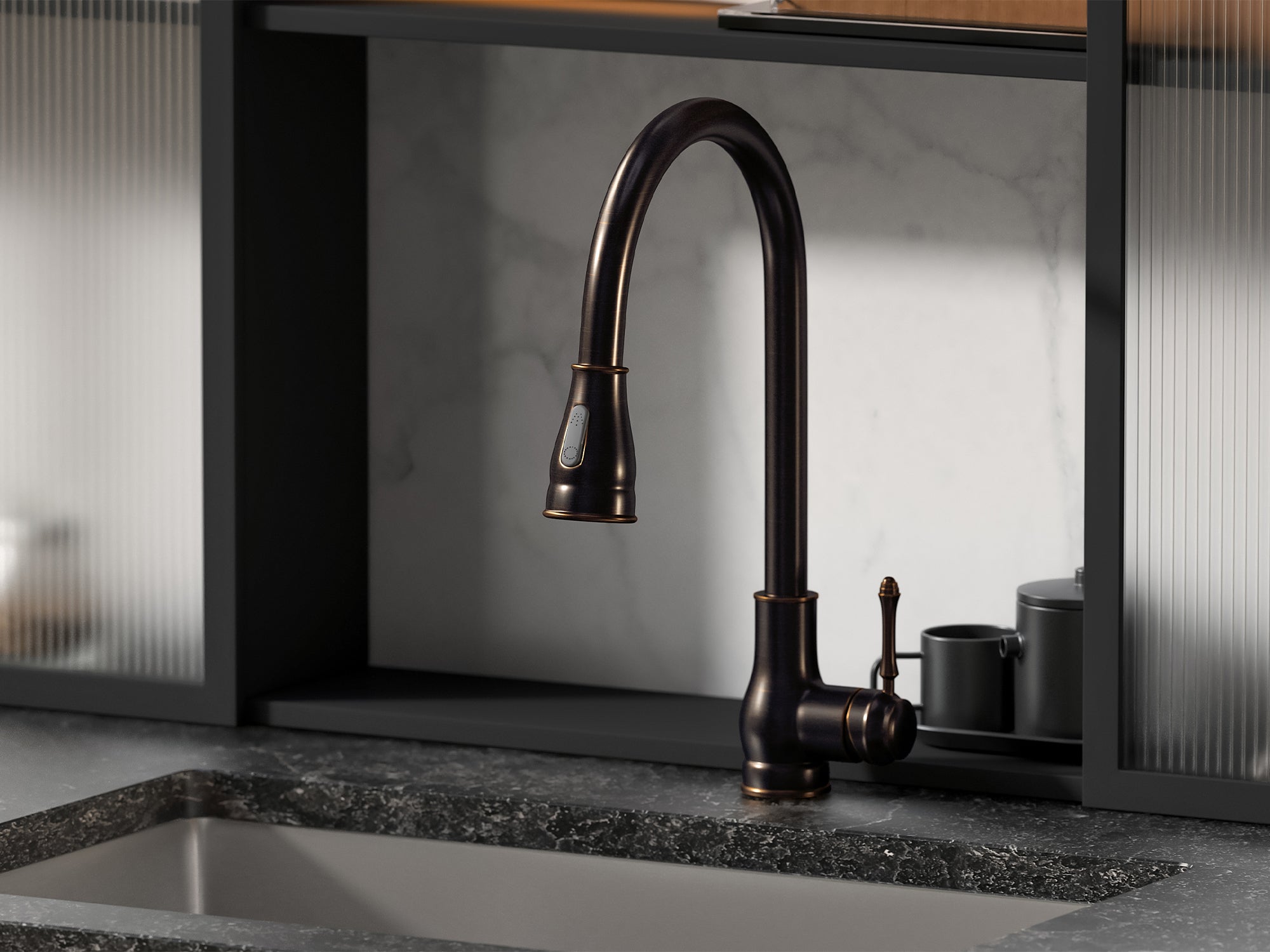
Pelican PL-8217
- Brass, lead-free construction
- Ceramic cartridge
- Brushed Nickel, Oil Rubbed Bronze, or Chrome
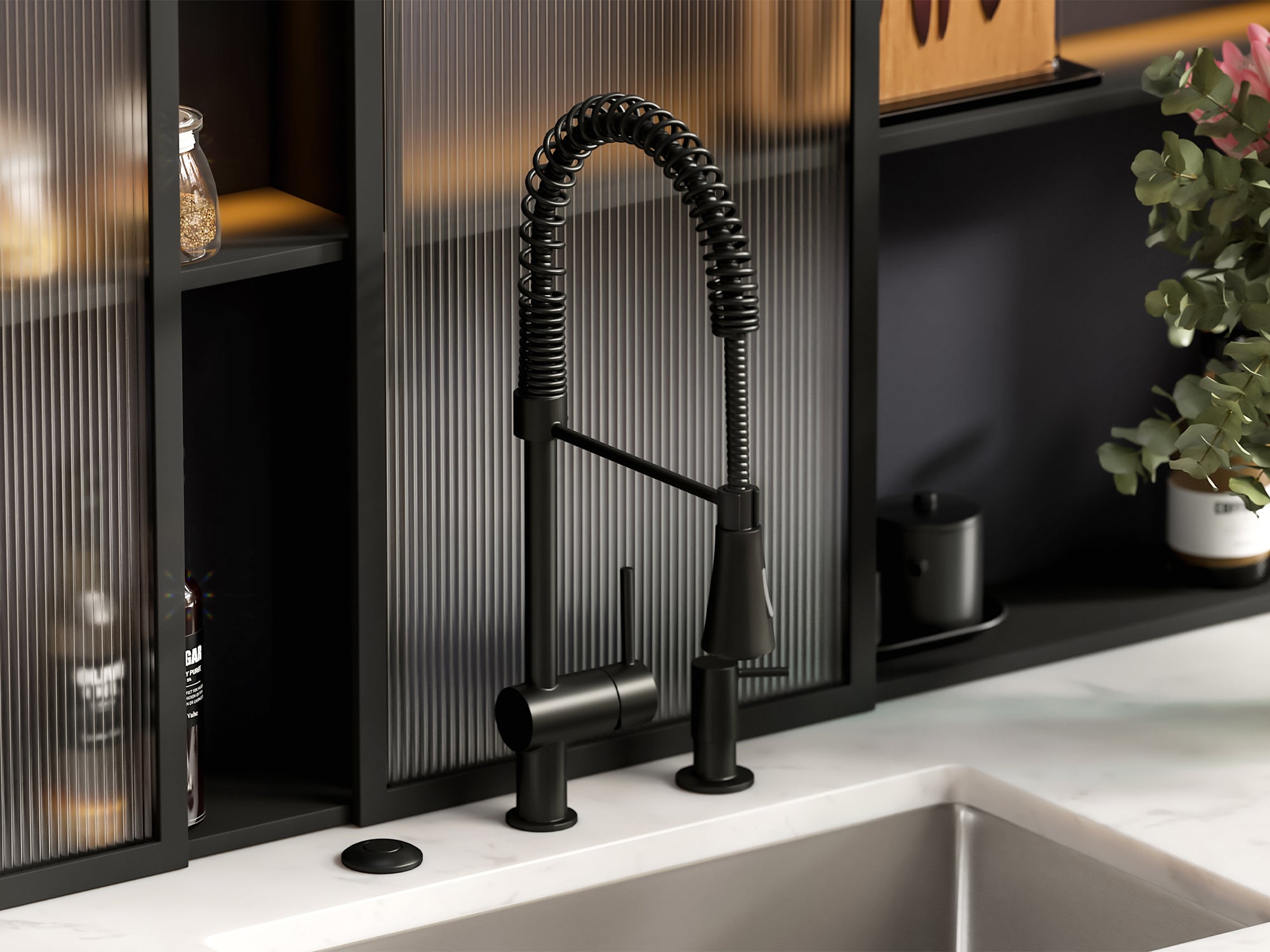
Pelican PL-8210
- High-profile 22½-inch design
- Brass, lead-free construction
- Ceramic cartridge and Matte Black option
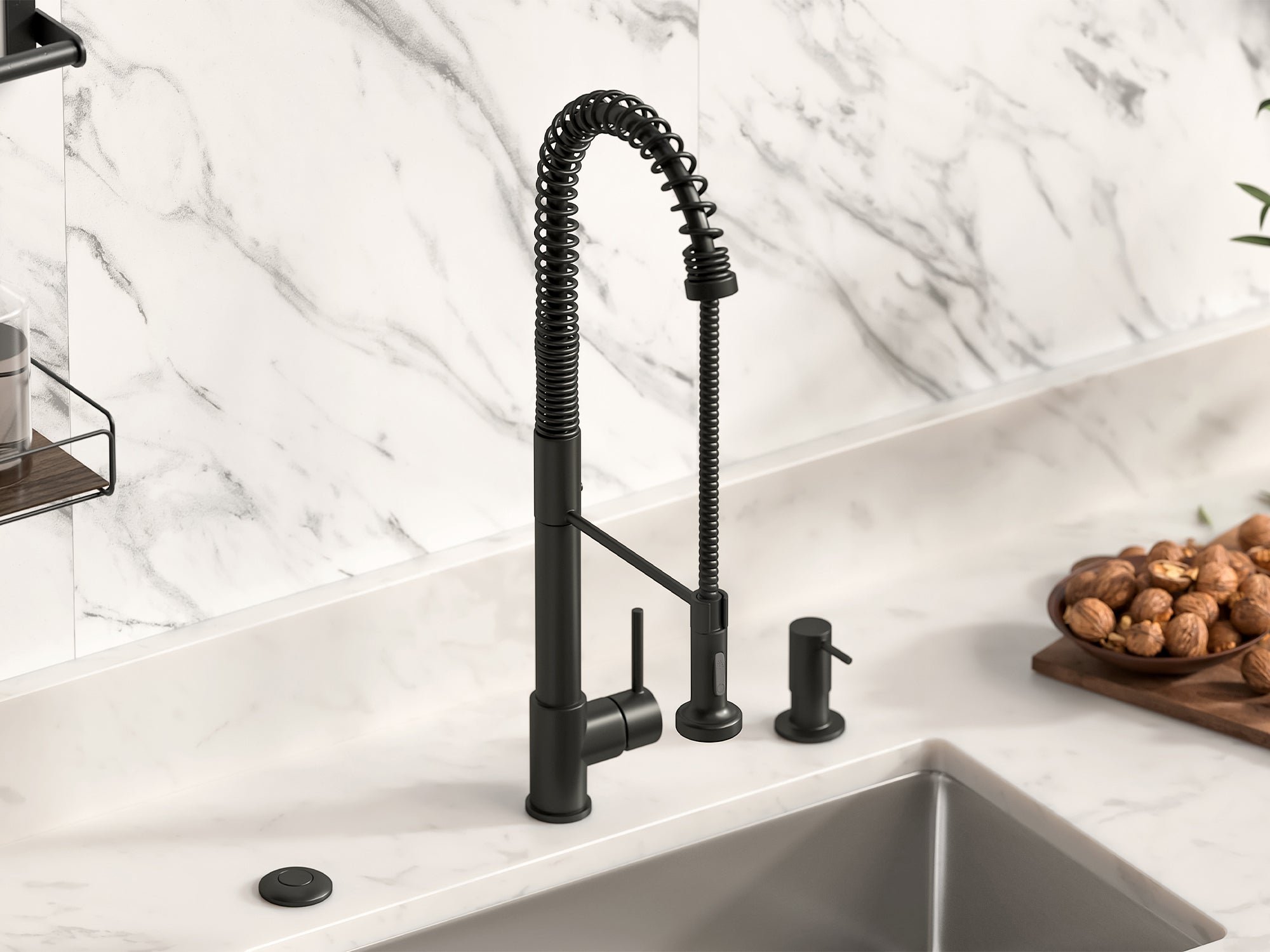
Pelican PL-8207
- Matte Black or Brushed Nickel
- Brass, lead-free construction
- Ceramic cartridge and limited lifetime warranty
Frequently asked questions
How do I know what kitchen faucet will fit my sink?
Determine how many mounting holes your sink or countertop has, then compare the faucet’s mounting requirements. Measure available height, spout reach, backsplash clearance, countertop thickness, and sink depth before ordering.
Can any kitchen faucet fit any kitchen sink?
No. Hole configuration, mounting dimensions, countertop thickness, clearance, and faucet size all affect compatibility.
Can I use a one-hole faucet with a three-hole sink?
Often yes. A compatible deck plate can cover the unused holes when the faucet and sink configuration permit it. Confirm whether the plate is included.
Is a pull-down or pull-out kitchen faucet better?
Pull-down faucets are especially useful with large and deep sinks and large cookware. Pull-out faucets can be advantageous where lower vertical height or greater horizontal reach matters more.
What faucet is best for a deep kitchen sink?
A pull-down faucet with appropriate spout reach is often an excellent choice because its movable sprayer makes it easier to reach the bowl and rinse larger cookware.
Are high-arc kitchen faucets better?
Not universally. They provide useful pot clearance but require more vertical space and may not fit below low cabinets, shelves, or windows.
Should my kitchen faucet match my sink?
It can, but it does not have to. Coordinated or intentionally contrasting finishes can work when the faucet, sink, cabinet hardware, appliances, and lighting are considered together.
What faucet is best for a workstation sink?
A high-arc pull-down faucet with good reach and multiple spray settings is usually a strong option for a wide workstation sink used for preparation, rinsing, and large pots.
Shop Related Kitchen Products
Ready to find your kitchen faucet?
Use your sink measurements and this checklist to compare compatible styles, then browse Cavalieri Flooring’s kitchen faucet collection.
Shop Kitchen Faucets