
What separates a luxury vinyl plank floor that looks dealer-perfect for fifteen years from one that buckles, gaps, and squeaks within a single Florida summer? It is almost never the product — it is the install. A successful luxury vinyl plank installation is built on what happens before the first plank clicks into place: a dead-flat subfloor, fully acclimated planks, a planned layout, and disciplined expansion gaps. Skip any one of those and even premium LVP will fail.
This guide walks through the exact subfloor-to-trim process our installers follow on Orlando jobs every week. You'll get the complete tool list, the manufacturer flatness spec professionals actually measure to, the acclimation rules that matter in Florida's heat, the floating-versus-glue-down decision, the right way to stagger and cut planks, and the handful of mistakes that quietly ruin otherwise great floors. Whether you tackle it yourself or hire a pro, you'll know exactly what a flawless install requires.
★ Key Takeaways
- The subfloor must be flat within 3/16" over 10 feet — grind high spots and fill low spots before any plank goes down.
- Acclimate LVP for 48 hours at living temperature; in Florida this prevents post-install shrinking and gapping.
- Leave a 1/4"–3/8" expansion gap at every wall and fixed object, and stagger end joints by at least 6" (8"+ is better).
- The biggest failures are skipping prep, omitting expansion gaps, and installing planks from a single box — all avoidable.
Tools & Materials
A professional luxury vinyl plank installation goes faster and cleaner when every tool is staged before you start. Stopping mid-row to find a tapping block is how rows drift out of square. Here is the complete kit our crews bring to an Orlando job site.
Tool Checklist
- Tape measure, pencil, and a carpenter's square
- Chalk line for establishing your starting reference line
- Utility knife with extra hook/snap blades (score-and-snap most cuts)
- Tapping block and a pull bar (never hammer planks directly)
- Rubber mallet
- Spacers (1/4" to 3/8") for the perimeter expansion gap
- Jamb saw or oscillating multi-tool for undercutting door casings
- Jigsaw or fine-tooth handsaw for curved and notch cuts
- 6-foot straightedge and a long level for checking subfloor flatness
- Cementitious self-leveling compound and a trowel for low spots
- Concrete grinder or sander for high spots
- 6-mil polyethylene vapor barrier (for floating installs over concrete)
- Moisture meter (and a calcium chloride or RH test for slabs)
- Approved adhesive and notched trowel (glue-down installs only)
- Knee pads, a sharp framing square, and a clean shop vacuum
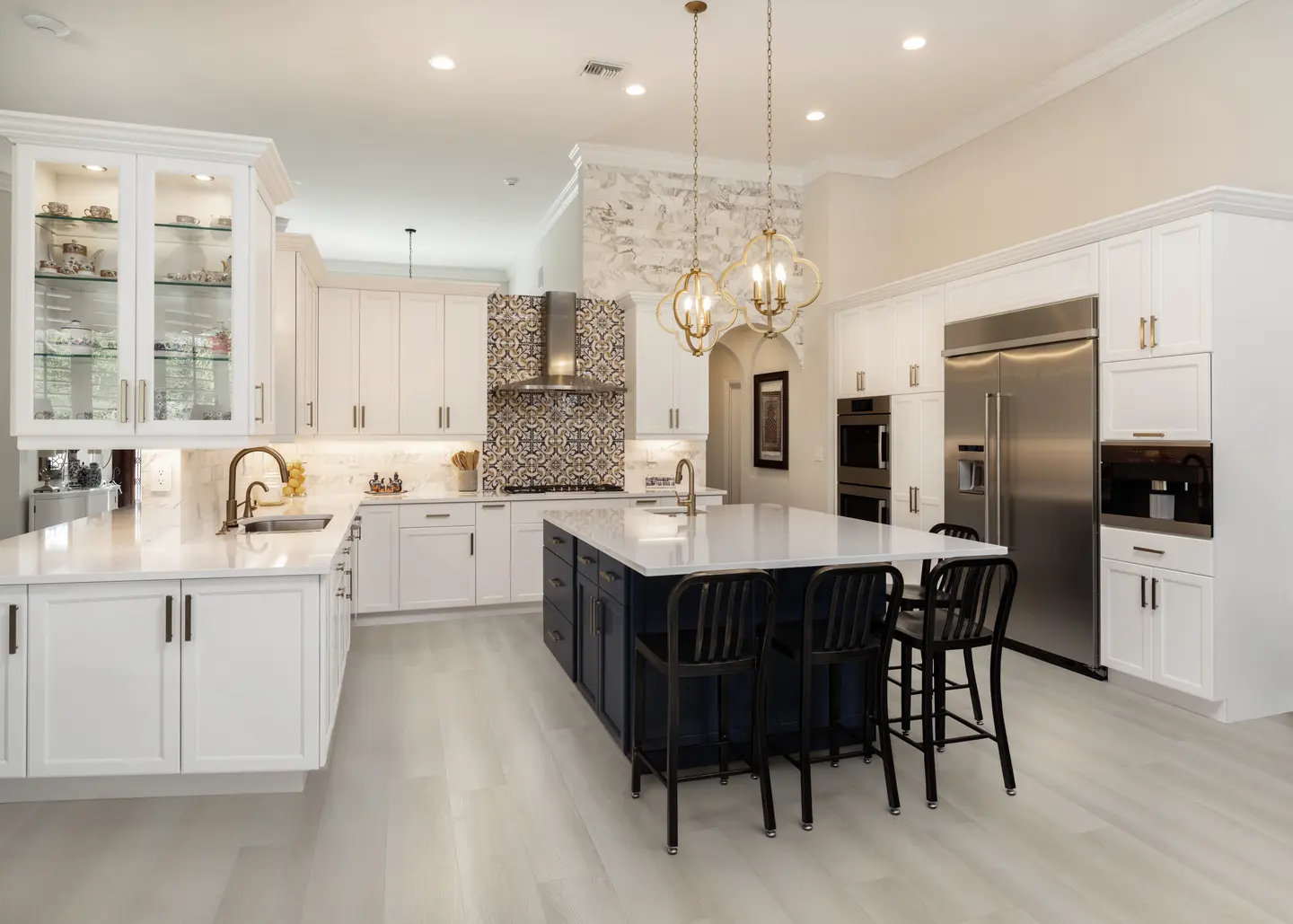
Two materials decisions matter before you buy anything else. First, confirm your plank's core type — rigid SPC (stone polymer composite) handles minor subfloor imperfections and heat better than flexible WPC, which is why most Orlando installs lean SPC. Second, check whether your plank has an attached underlayment pad; if it does, you do not add a separate pad on top (more on that below). When in doubt, browse our luxury vinyl plank collections and confirm the spec sheet before ordering.
Subfloor Prep & Leveling
This is the single most important — and most skipped — stage of any LVP install. Vinyl plank is thin and conforms to whatever is beneath it over time. A dip you can barely see today becomes a hollow, flexing spot that stresses the locking joints until they separate. Get the subfloor right and the floor lasts; cut this corner and nothing above it can save you.
The Flatness Standard
Most LVP manufacturers require the subfloor to be flat within 3/16 inch over a 10-foot span, and roughly 1/8 inch over 6 feet. Pull a 6-foot straightedge across the floor in multiple directions and mark every gap. Grind down high spots on concrete with a concrete grinder, and fill low spots with a cementitious self-leveling compound. On plywood subfloors, sand high seams and screw down any squeaky or loose areas before patching.
Cleaning, Repair & Moisture
The subfloor must be clean, dry, and structurally sound. Remove old adhesive residue, fasteners, and debris — even a single staple telegraphs through vinyl. Replace any soft, rotted, or water-damaged subfloor sections entirely. For concrete slabs, which are the norm in Orlando, test for moisture before installing. Slabs release significant vapor, and trapped moisture causes adhesive failure on glue-down installs and mold under floating floors. If you're floating LVP over a slab, lay a 6-mil polyethylene vapor barrier (unless your plank's attached pad is rated as a vapor barrier). For a deeper look at why this matters here, see our guide on flooring for Florida humidity.
Acclimation & Layout Planning
LVP is dimensionally stable, but it is not immune to temperature. A plank installed while still warm from a hot delivery truck or garage will contract once the room reaches living temperature — and a floating floor that contracts after it's locked together opens gaps at the seams. Acclimation prevents this.
How to Acclimate
Lay the boxes flat in the room where the floor will be installed and let them sit for at least 48 hours with the HVAC running at normal living temperature (about 65–85°F). This step is non-negotiable in Florida, where planks are routinely stored in hot garages or sun-baked trucks. Do not stand boxes on end, and do not stack them so high that the bottom boxes can't reach room temperature. The goal is for every plank to match the room's conditions before installation.
Planning the Layout
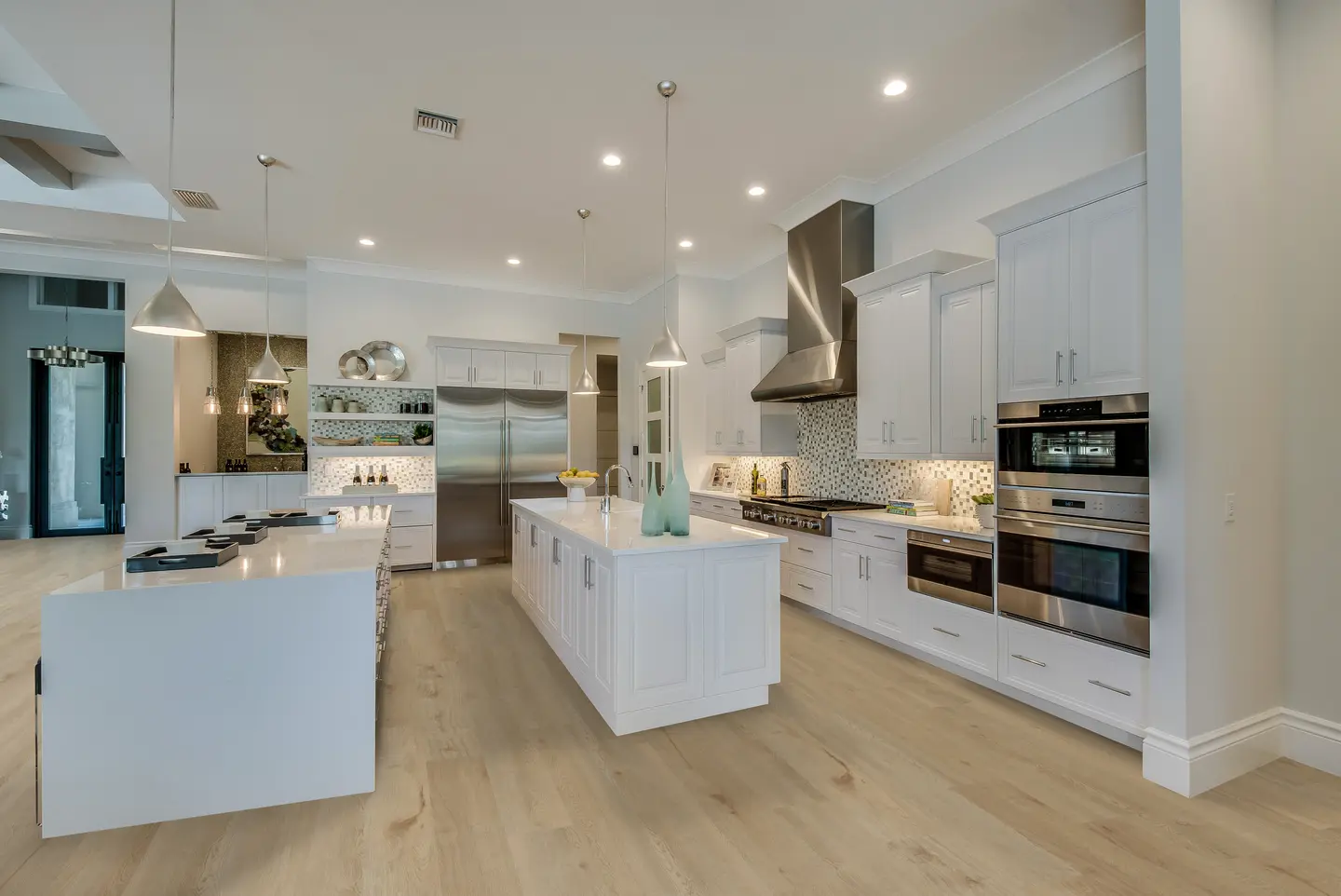
Smart layout planning is what makes a floor look professionally installed. Measure the room and calculate the width of the final row — if it works out to less than about a third of a plank wide, rip the first row narrower so the first and last rows are balanced. Run planks parallel to the longest wall or toward the main light source for the most natural look. Plan your stagger across the whole room: end joints in adjacent rows should be offset by a minimum of 6 inches, and 8–10 inches looks more natural and locks more securely. Avoid lining up seams (weak H-joints) and avoid a repeating step pattern. Open several boxes and mix planks together as you go so natural color and pattern variation blends evenly instead of pooling in one area.
Step-by-Step Installation
With the subfloor prepped, the planks acclimated, and a layout planned, the install itself is methodical. Here is the sequence our crews follow for a floating click-lock floor — the most common residential method.
Step 1 — Undercut door casings. Lay a scrap plank flat beside each door jamb and use a jamb saw or oscillating tool to cut the casing at plank height. This lets the floor slide underneath for a clean, professional edge instead of an awkward cut around the trim.
Step 2 — Lay the vapor barrier (if floating over concrete). Roll out the 6-mil poly, overlap seams by several inches, tape them, and run it a couple of inches up the walls (you'll trim it after baseboard goes on).
Step 3 — Set your first row. Place 1/4"–3/8" spacers along the starting wall and begin in a corner. Lay the first row with the tongue side facing the wall, connecting planks end to end. Snap a chalk line if the wall isn't straight and scribe the first row to follow it — a straight first row makes every row after it easier.
Step 4 — Build out row by row. Start each new row with the cut-off piece from the previous row when it maintains your 6"+ stagger; otherwise cut a fresh plank. Angle the long edge into the locked row and drop it down, then snug end joints with a tapping block and pull bar. Never strike the plank directly with a mallet.
Step 5 — Maintain the expansion gap. Keep spacers at every wall, cabinet, post, and pipe so the perimeter gap stays consistent at 1/4"–3/8". This is what lets the floor expand and contract without buckling.
Step 6 — Cut around obstacles. Use a jigsaw for pipes and curves and score-and-snap with a utility knife for straight cuts. For pipes, drill a hole slightly larger than the pipe, then cut a slot so the plank fits around it.
Step 7 — Fit the final row. Measure and rip the last row to width (remembering the expansion gap) and pull it tight with the pull bar. If the final row is very narrow, glue it for stability.
Step 8 — Install transitions and trim. Add T-moldings, reducers, and thresholds at doorways and where the floor meets other surfaces, then install baseboard or quarter round to hide the expansion gap. Fasten trim to the wall, never to the floor, so the floor can still move. Browse matching vinyl accessories and trims to coordinate the finish.
One pro note on the floating-versus-glue-down question: for very large continuous areas, rooms with intense direct sun, commercial traffic, or stairs, we often recommend a full glue-down install instead. Glue-down resists movement and feels more solid underfoot, but it demands a flawless, fully cured, moisture-tested subfloor and adds adhesive open and cure time. We make that call based on room size, light exposure, and slab condition — and you can read more on budgeting either method in our vinyl installation cost guide.
Common Mistakes That Ruin LVP
Nearly every failed LVP floor we're called to fix traces back to one of a handful of avoidable errors. If you do nothing else right, avoid these.
- Skipping subfloor prep. Installing over an uneven or dirty subfloor guarantees flexing, hollow spots, and separated joints. This is the number-one cause of callbacks.
- Omitting the expansion gap. A floor butted tight to the walls has nowhere to go when it heats up in a sunny Florida room — it lifts and buckles. Always leave 1/4"–3/8".
- Installing planks from a single box. One box can carry a slightly different shade or pattern run; using boxes one at a time creates visible color blocks. Mix several boxes as you go.
- No moisture barrier on a slab. Floating over bare concrete without a vapor barrier invites trapped moisture and mold. Test the slab and protect it.
- Insufficient stagger / H-joints. End seams that line up or sit closer than 6" create weak points and an unnatural look.
- Skipping acclimation. Installing warm planks leads to post-install shrinkage and gapping once the room cools to living temperature.
- Fastening trim to the floor. Nailing baseboard or transitions into the planks pins a floating floor in place and forces it to buckle. Fasten trim to the wall only.
- Installing over a damaged subfloor. Rotted or soft sections must be replaced first — vinyl will not bridge a failing substrate.
For an honest look at which of these are realistic to handle yourself versus where a pro pays for itself, read why professional installation trumps DIY. And if you're still deciding whether you need underlayment at all, our LVP underlayment guide covers the attached-pad rule in detail.
The Cavalieri Approach to Vinyl Plank Installation in Orlando
At Cavalieri Flooring, every luxury vinyl plank installation starts with the parts homeowners can't see. Before a single plank is laid, our crews test slab moisture, straightedge the subfloor in multiple directions, grind and level to the manufacturer's flatness spec, and confirm the planks have acclimated. That discipline is why our floors stay flat and tight through Florida's heat and humidity swings.
We install both floating and full glue-down systems and recommend the right method for your room — accounting for square footage, direct sun, and slab condition — rather than defaulting to whatever is fastest. Every install includes a planned, balanced layout, a proper expansion gap, matched transitions, and a workmanship guarantee. If you're choosing a floor first, our team can walk you through the full vinyl plank lineup and pair it with the correct underlayment and trims, or coordinate a full professional install through our luxury vinyl flooring installation service.
Visit our showroom at 4301 36th St #101, Orlando, FL 32811, call (321) 424-0546, or request a free estimate online. Open Monday–Friday, 7:00 AM–5:00 PM & Saturday, 9:00 AM–3:00 PM.
Frequently Asked Questions
Can you install luxury vinyl plank yourself, or do you need a professional?
A handy homeowner can install floating click-lock LVP in a small, square room. However, large open areas, glue-down installs, uneven subfloors, and complex layouts with many doorways are where professionals earn their fee. The most common DIY failures are skipping subfloor leveling and omitting expansion gaps, both of which cause buckling and gapping that voids the warranty. For whole-home or high-traffic Orlando installs, professional installation protects your investment.
How flat does the subfloor need to be for vinyl plank?
Most LVP manufacturers require the subfloor to be flat within 3/16 inch over a 10-foot span (and roughly 1/8 inch over 6 feet). High spots must be ground down and low spots filled with a cementitious leveling compound. Rigid SPC cores tolerate minor imperfections better than flexible WPC, but no vinyl bridges a significant dip without telegraphing it or stressing the locking joints over time.
Do you need an expansion gap when installing LVP?
Yes. Floating vinyl plank expands and contracts with temperature swings, so you must leave a 1/4-inch to 3/8-inch expansion gap at every wall and fixed vertical object (cabinets, pipes, door jambs). The gap is hidden under baseboard or quarter round. In hot Florida rooms with large windows or sliding doors, the gap is critical because direct sun heats the floor and drives expansion. Skipping it is the number-one cause of buckling.
How long should luxury vinyl plank acclimate before installation?
Acclimate LVP for at least 48 hours in the room where it will be installed, with the boxes laid flat and the HVAC running at normal living temperature (around 65 to 85 degrees F). This matters most in Florida, where planks are often stored in hot garages or trucks. Installing planks that are still warm or cold leads to dimensional movement after the floor is locked together.
Should I install vinyl plank floating or glue-down?
Floating click-lock is faster, cleaner, and ideal for most residential rooms. Full glue-down is preferred for very large continuous areas, rooms with extreme heat or direct sun, commercial traffic, and stairs. Glue-down resists movement and feels more solid underfoot but requires a flawless, fully cured, moisture-tested subfloor. We recommend the method based on your room size, light exposure, and subfloor condition.
How much should planks be staggered during installation?
Stagger end joints by a minimum of 6 inches (8 to 10 inches looks more natural and is stronger). Never let end seams in adjacent rows line up or fall closer than 6 inches, which creates weak H-joints. Avoid a repeating step or staircase pattern. Plan your stagger across the whole room and mix planks from several boxes at once so color and pattern variation blend evenly.
Do I need a moisture barrier for vinyl plank over a concrete slab?
For floating LVP over a concrete slab, you should install a 6-mil polyethylene vapor barrier (or use planks with an attached pad rated as a vapor barrier) unless the manufacturer states otherwise. Orlando slabs release significant moisture, and trapped vapor can cause adhesive failure and mold. Glue-down installs require a moisture test and often a manufacturer-approved moisture-mitigation primer before troweling adhesive.
How long does a professional LVP installation take?
A professional crew typically installs 750 to 1,000 square feet of floating LVP per day once the subfloor is prepped. A standard Orlando home of 1,000 to 1,500 square feet usually takes one to two days, plus any time needed for leveling, demolition of old flooring, and acclimation. Glue-down installs take longer because of adhesive open time and curing.
Ready for a Professional Vinyl Plank Install in Orlando?
Get a free estimate for luxury vinyl plank installation from Cavalieri Flooring. We serve all Central Florida neighborhoods.
Or call us now: (321) 424-0546
Related Articles & Resources
Get a Flawless LVP Floor — Without the Guesswork
A luxury vinyl plank floor is only as good as the prep and technique beneath it. From slab moisture testing and leveling to a balanced, perfectly staggered layout with proper expansion gaps, the details decide whether your floor lasts fifteen years or fifteen months.
At Cavalieri Flooring in Orlando, our crews handle every step the right way — and back it with a workmanship guarantee. Skip the callbacks and let the pros deliver a gap-free, dealer-perfect result the first time.
Schedule Free Vinyl Installation Estimate