
You picked the perfect plank, scheduled the install, and then a strip of bare edge appears in the doorway, the stairs end in an exposed lip, and a gap runs along every wall. The flooring itself was the easy part — the flooring accessories are what actually make a room look finished. These small profiles, the T-moldings, reducers, stair nosing, thresholds, and quarter round, are the difference between a professional result and an installation that looks unfinished, catches toes, and chips at the edges within months.
The frustrating truth is that most homeowners don't think about transitions until they're standing in the aisle, unsure whether they need a T-molding or a reducer for a doorway. This guide removes that guesswork. You'll learn exactly what each accessory does, which one to use for every situation in your Orlando home, how flush and overlap stair nosing differ, and how to match every trim piece to your floor so the whole space reads as one seamless surface.
★ Key Takeaways
- Each transition solves a specific problem — T-molding for equal heights, reducer for height changes, end cap for edges that stop.
- Floating floors need expansion gaps, and trim like quarter round and transitions exist to hide them while letting the floor move.
- Stair nosing comes in overlap (floating floors) and flush (glue-down) profiles — choosing the wrong one creates a lip or restricts movement.
- Match accessories to your floor by buying the same collection's color-keyed trims — Cavalieri stocks matching profiles per collection.
Why Accessories Matter
Flooring accessories are not decorative afterthoughts — they are functional engineering. Modern luxury vinyl and laminate are floating floors, meaning the planks lock together and rest on top of the subfloor rather than being nailed or glued down. As temperature and humidity change, the entire floor expands and contracts as a single sheet. To allow that movement, installers leave a deliberate expansion gap — typically 1/4 inch to 3/8 inch — around the perimeter of every room and wherever the floor meets a fixed surface. Accessories exist to cover those gaps and protect the exposed plank edges.
In Orlando's humid subtropical climate, this movement is more pronounced than in drier regions. A floor that runs uninterrupted across too large an area, or one that butts tightly against a wall with no gap, will eventually peak, buckle, or pop apart at the seams. The right trim isn't optional — it's what keeps your warranty valid and your floor flat. Beyond function, accessories deliver the visual polish: a clean line where wood meets tile, a safe rounded edge on a stair, and a tidy base along every wall.
The Two Jobs Every Accessory Does
- Protect: Plank edges and cores are vulnerable where the floor ends. Trim caps and seals those edges against moisture, impact, and chipping.
- Allow movement: Transitions and quarter round bridge or hide expansion gaps so the floor can breathe without buckling.
The Transition Types Explained
There are five core accessory profiles, plus one clever all-in-one solution. Once you understand what each one is shaped to do, choosing the right piece becomes obvious. Here's the complete lineup:
T-Molding
Shaped like the letter T, a T-molding sits down into the gap between two floors of equal or nearly equal height and laps over both edges. It's the classic doorway transition between two hard floors of the same thickness — for example, luxury vinyl in a hallway meeting luxury vinyl in a bedroom. It's also the right choice to break up a long continuous run so the floor has room to expand.
Reducer
A reducer joins a higher floor to a lower one. It has a tall edge that meets your plank and slopes down to a thin edge that rests on the lower surface — think luxury vinyl plank meeting ceramic tile, low-pile carpet, or a thin sheet floor. The gentle ramp eliminates a trip hazard and gives a smooth visual step-down.
End Cap / Threshold (Square Nose)
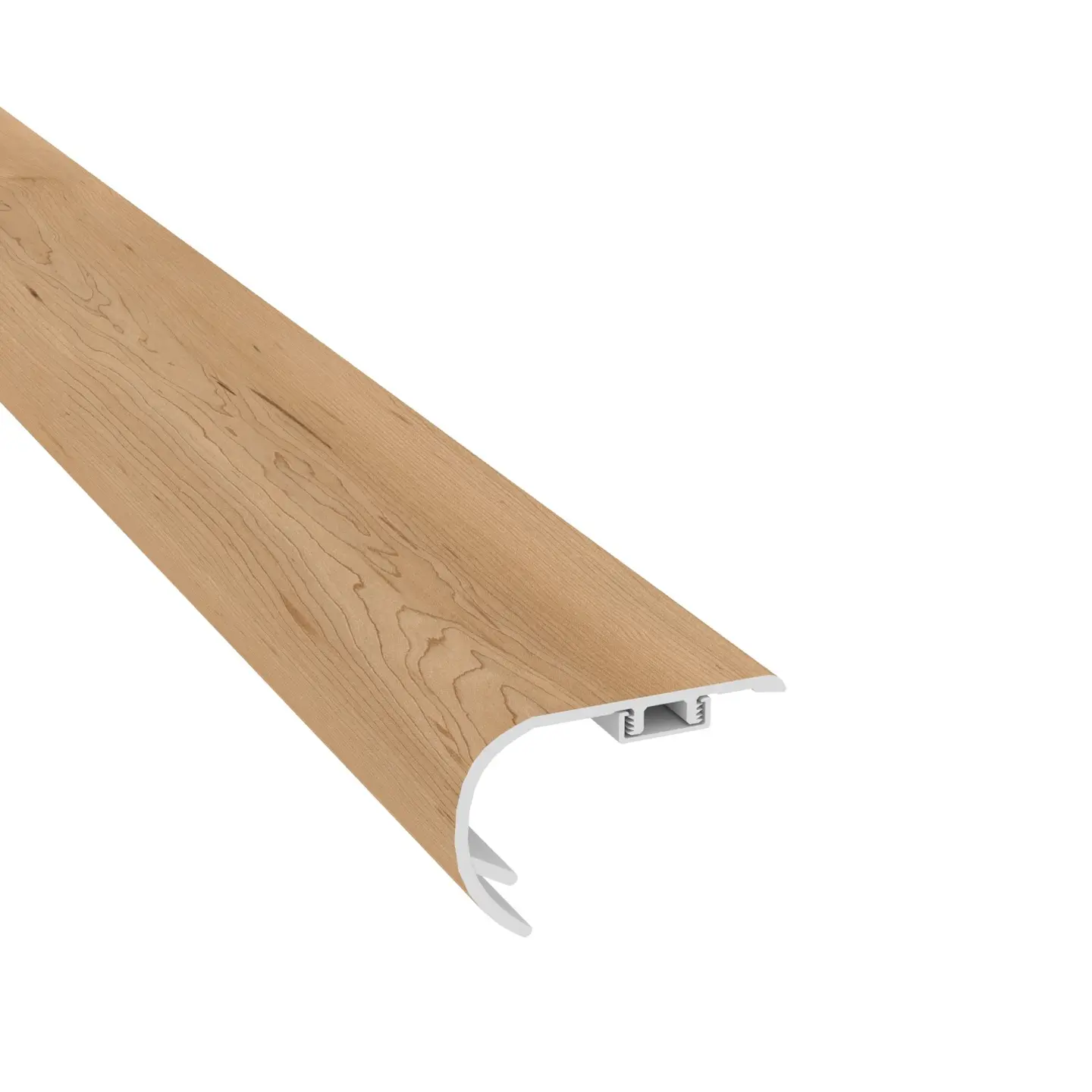
An end cap — also called a threshold or square nose — finishes the exposed edge of a floor where it stops against a fixed object that isn't another hard floor. Use it where your plank meets a sliding glass door track, an exterior threshold, a fireplace hearth, or carpet. It provides a clean stopping point and protects the last row of planks.
Quarter Round / Shoe Molding
Quarter round is a small, rounded trim installed at the base of the wall along the baseboard. Its job is to cover the expansion gap between the floor and the wall. Critically, it is nailed to the baseboard, never to the floor — so the floor can still float freely underneath. It's the finishing touch that makes the perimeter look intentional.
Stair Nosing
Stair nosing wraps and protects the front edge of a step. It creates a safe, rounded edge, hides the seam where the tread meets the riser, and stands up to the heavy wear that stair edges endure. It comes in two profiles — overlap and flush — covered in detail below.
Multi-Purpose Trim (4-in-1)
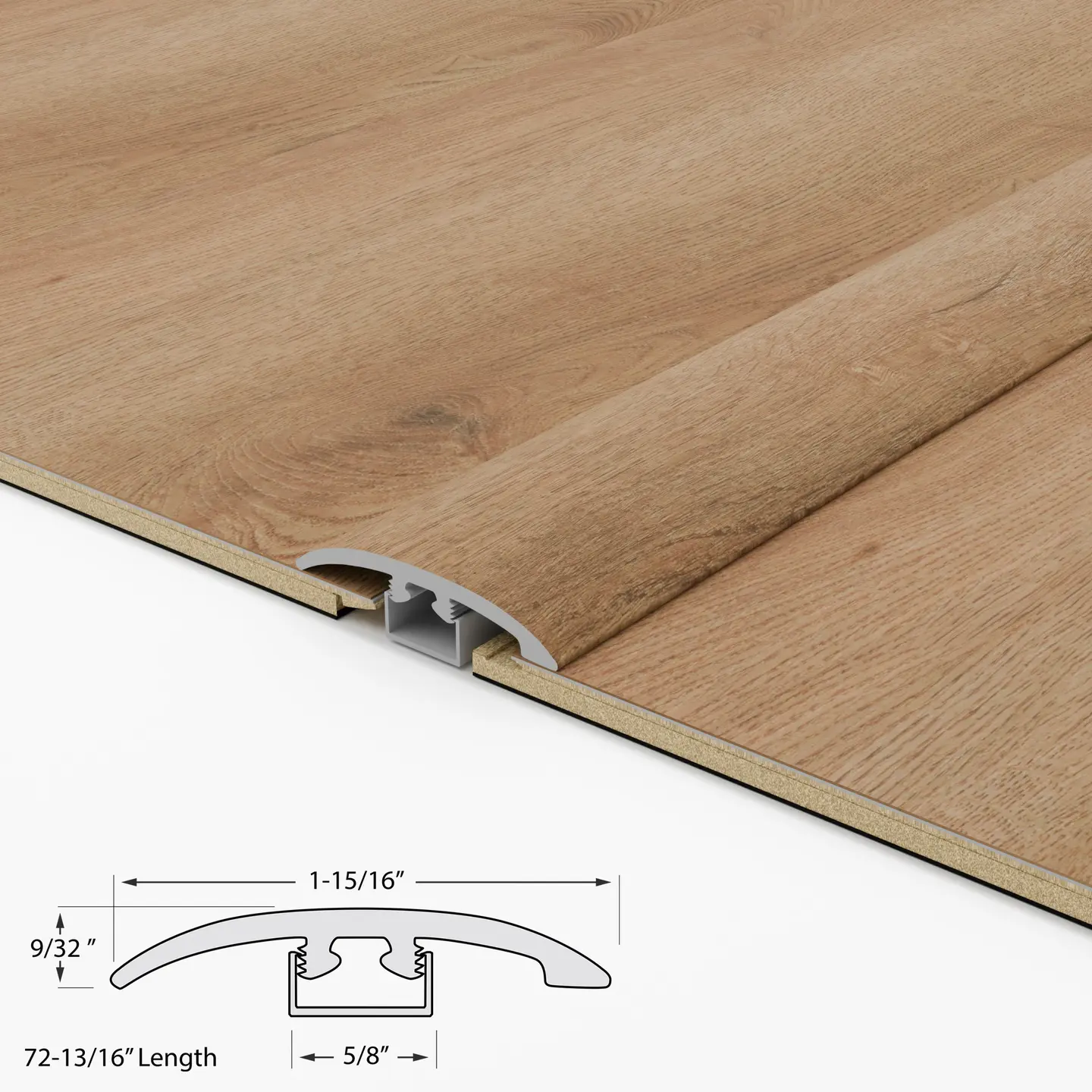
A multi-purpose trim is a single kit with a track and interchangeable caps. Depending on which cap you snap in, it serves as a T-molding, reducer, end cap, or stair nosing. It's a smart, waste-reducing option because one color-matched product covers nearly every transition need. Cali offers these in profiles keyed to each vinyl collection, so you can buy a single matched trim and configure it room by room.
Which Transition to Use — Decision Guide
When you're standing at a transition point, ask one question first: what's on the other side, and is it the same height? This quick-reference table maps every common situation to the right accessory.
| Situation | Use This Accessory |
|---|---|
| Two hard floors, same height, in a doorway | T-molding |
| Higher floor meets lower floor (vinyl to tile/carpet) | Reducer |
| Floor meets sliding door, hearth, or carpet edge | End cap / threshold |
| Floor meets the wall (perimeter gap) | Quarter round / shoe |
| Front edge of a stair tread | Stair nosing |
| Long continuous run over ~30–40 ft | T-molding (expansion break) |
| Want one product to cover several needs | Multi-purpose 4-in-1 trim |
Two rules competitors gloss over: first, every doorway and most room-to-room openings need a transition because the floor needs an expansion gap there. Second, any single run longer than roughly 30 to 40 feet should be broken with a T-molding to give the floor room to move — skipping this is a leading cause of buckling in large open-plan Orlando homes. When you plan your floor, plan the transitions at the same time so nothing is left exposed. For installation specifics across an entire home, our luxury vinyl flooring installation team maps every transition before the first plank goes down.
Stair Nosing & Trim
Stairs are where accessory selection matters most — both for looks and for safety. The single most important decision is the nosing profile, and it's determined by how your floor is installed, not by preference.
Overlap vs. Flush Stair Nosing
- Overlap (overlapping) nosing: Used with floating floors. It laps over the edge of the plank and leaves a small space underneath so the floor can expand and contract. This is the correct profile for click-lock luxury vinyl and laminate stairs.
- Flush nosing: Used with glue-down installations. It sits even with the floor surface because a glued floor is fixed in place and doesn't need an expansion allowance. Flush gives the cleanest, most seamless look but only works when the tread is bonded down.
Choosing the wrong profile is a common and costly mistake. Put a flush nosing on a floating floor and you remove the expansion room the floor needs; put an overlap nosing on a glue-down stair and you create a raised lip that catches feet. On stairs especially, that lip is a genuine trip hazard. Because stairs take more concentrated wear and carry real safety stakes, stair nosing should always be installed with construction adhesive and, where appropriate, mechanical fasteners — not relied on to simply click into place.
Quarter Round and Base Trim on Stairs
Risers, the vertical face of each step, are often finished with a matching riser piece or a thin trim, and the junction between tread and wall can be tidied with shoe molding. Coordinating these with the tread and nosing is what makes a staircase look custom rather than pieced together. For a deeper look at making stairs and floors read as one, see our guide on coordinated stair treads and flooring.
Matching Accessories to Your Floor

The secret to a high-end result is simple: buy your accessories from the same collection as your flooring. Manufacturers like Cali produce T-moldings, reducers, stair nosing, thresholds, and quarter round in colors keyed to each individual plank style. That means the wood grain, sheen, and tone match exactly, and the eye reads the transitions as part of the floor rather than as separate strips. Mixing a generic trim with a premium plank is the fastest way to make an expensive floor look cheap.
When an Exact Match Isn't Available
- Go slightly darker: If you can't find an exact tonal match, choose a coordinating trim a shade darker than the floor. A darker transition reads as a deliberate accent; a lighter mismatched one stands out awkwardly.
- Compare samples side by side: Lighting changes everything. View the plank and the trim together under the same light before committing — exactly what our showroom is set up for.
- Match across materials: When transitioning to a different floor type (say, vinyl to hardwood), match the trim to the more prominent or more expensive of the two surfaces.
Cavalieri stocks coordinated accessories for the collections we carry — explore matching profiles for vinyl, hardwood, laminate, and bamboo floors, so every edge of your project ties together.
The Cavalieri Approach
At Cavalieri Flooring, we treat accessories as part of the floor, not an upsell tacked on at the register. When we quote a project, we map every doorway, height change, stair, and perimeter run, then specify the exact color-matched trim for each one. That planning step is why our installations look seamless — there are no surprise bare edges, no mismatched strips, and no buckling from a missing expansion break.
We carry coordinated transitions, stair nosing, thresholds, and quarter round keyed to the vinyl, laminate, hardwood, and bamboo collections we stock, and our installers fit them with the correct adhesives and fasteners so they stay put for the life of the floor. Whether you're finishing a single room or running new flooring through an entire home, we'll make sure every edge is protected and every transition disappears into the design.
Visit our showroom at 4301 36th St #101, Orlando, FL 32811, call (321) 424-0546, or request a free estimate online. Open Monday–Friday, 7:00 AM–5:00 PM & Saturday, 9:00 AM–3:00 PM.
Frequently Asked Questions
What is the difference between a T-molding and a reducer?
A T-molding joins two floors of equal or nearly equal height in a doorway — it sits in the gap and laps over both edges, shaped like the letter T. A reducer joins a higher floor to a lower one, such as luxury vinyl plank meeting tile or a thin sheet floor; it slopes down to gently bridge the height difference. Use a T-molding for same-height transitions and a reducer whenever the two surfaces differ in thickness.
Do I really need transition strips in doorways?
Yes, in most cases. Floating floors like luxury vinyl and laminate need expansion gaps where they meet other rooms or different surfaces, and a transition strip hides that gap while protecting the exposed plank edges. Transitions are also recommended for any continuous run longer than about 30 to 40 feet to allow the floor to expand and contract. Skipping them can lead to buckling, peaking, and chipped edges.
What is quarter round molding used for?
Quarter round, also called shoe molding, is a small rounded trim installed at the base of the wall along the baseboard. Its job is to cover the expansion gap left between the flooring and the wall, giving the room a clean, finished edge. It is nailed to the baseboard, never to the floor, so the floor can still float and move freely underneath.
Should stair nosing be flush or overlap?
It depends on how the floor is installed. Overlap (or overlapping) stair nosing is used with floating floors — it laps over the plank edge and leaves room for expansion. Flush stair nosing sits even with the floor surface and is used with glue-down installations where the floor is fixed in place. Choosing the wrong profile can leave a lip, expose the plank core, or restrict needed movement.
How do I match transition strips to my floor?
The easiest way is to buy matching accessories from the same collection as your flooring. Manufacturers like Cali produce T-moldings, reducers, stair nosing, thresholds, and quarter round in colors keyed to each plank style, so the grain and tone blend seamlessly. If an exact match is unavailable, choose a coordinating tone slightly darker than the floor, or visit our showroom to compare samples side by side.
What is a multi-purpose trim or 4-in-1 molding?
A multi-purpose trim is a single molding kit with a track and interchangeable caps that can be configured as a T-molding, reducer, end cap, or stair nosing depending on which pieces you snap in. It is convenient because one color-matched product covers several transition needs, reducing waste and simplifying ordering. Cali offers these in profiles matched to each vinyl collection.
What transition do I use where flooring meets carpet or a sliding door?
Use an end cap, also called a threshold or square nose. It finishes the exposed edge of a hard floor where it meets carpet, a sliding glass door track, an exterior threshold, or a fireplace hearth. The end cap provides a clean stopping point and protects the plank edge in spots where the floor does not continue into another hard surface.
Can I install flooring accessories myself?
Many homeowners install quarter round and simple T-moldings themselves, but reducers, stair nosing, and thresholds require precise cutting, the correct adhesive, and proper allowance for expansion — mistakes here cause squeaks, lifting, and safety hazards on stairs. For a seamless, durable result, especially on stairs and across multiple rooms, professional installation is recommended. Cavalieri Flooring installs matched trims with every flooring project in Orlando.
Need Matching Trim & Transitions in Orlando?
Get a free estimate for coordinated flooring accessories and installation from Cavalieri Flooring. We serve all Central Florida neighborhoods.
Or call us now: (321) 424-0546
Related Articles & Resources
- Stair Tread vs. Stair Nosing for LVP: Which One Do You Need?
- 5 Wins of Coordinated Stair Treads
- Why Professional Installation Trumps DIY
- Shop Vinyl Flooring Accessories
- Shop Hardwood Flooring Accessories
- Shop Laminate Flooring Accessories
- Shop Bamboo Flooring Accessories
- Shop Luxury Vinyl Plank
- Vinyl Installation Services in Orlando
- Get a Free Flooring Estimate
The Right Trim Makes the Whole Floor Look Custom
Transitions, stair nosing, and quarter round are small pieces with an outsized impact — they protect your investment, keep your warranty valid, and turn a good install into a flawless one. Choosing and matching them correctly is exactly the kind of detail that separates a professional job from a DIY one.
At Cavalieri Flooring in Orlando, we map every transition, source color-matched accessories for your collection, and install them to last — so every edge of your floor disappears into the design.
Schedule Your Free Accessory Consultation