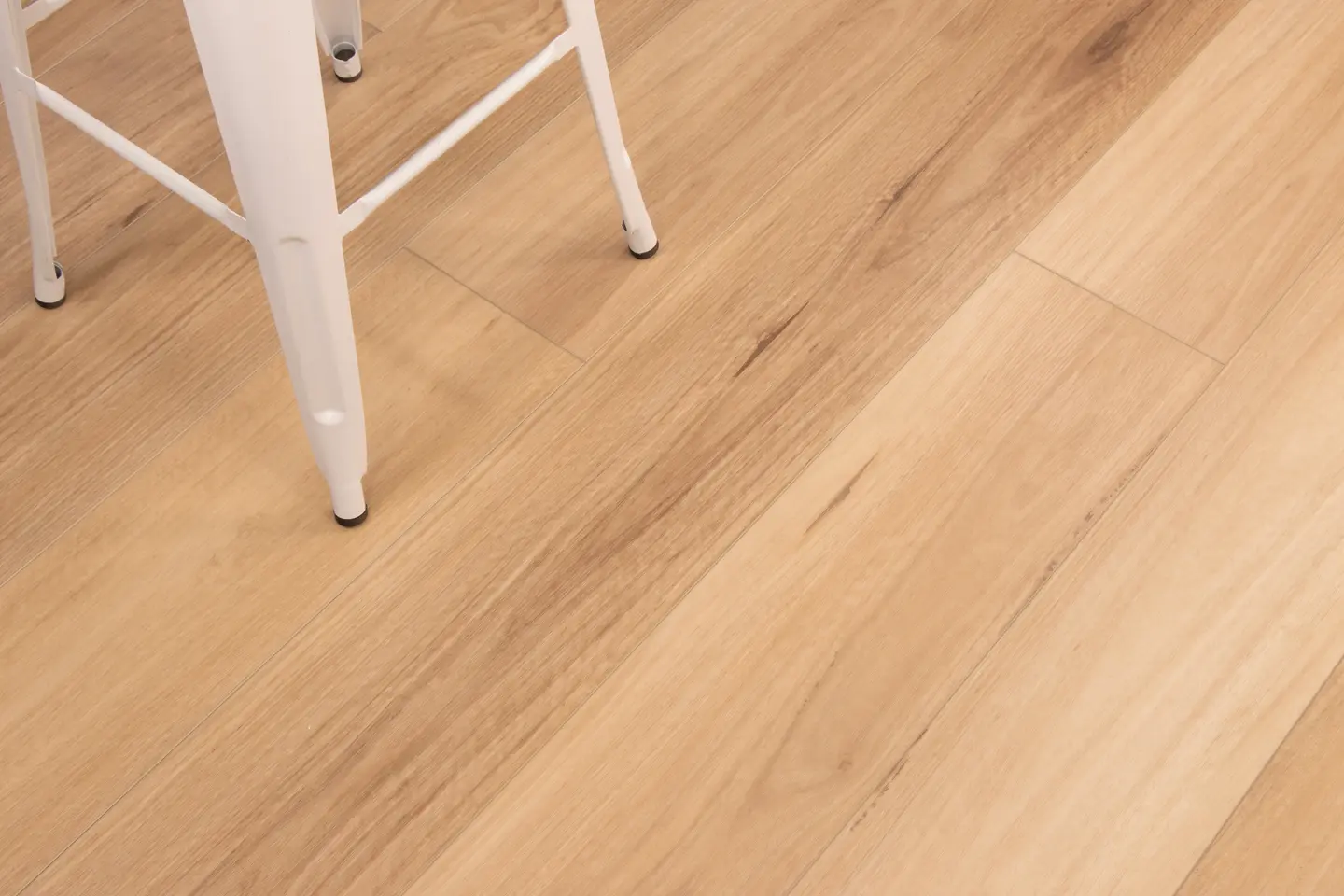
Your laundry room floor quietly absorbs more punishment than almost any other surface in your home. Between the slow, undetected drip beneath the washer, the steam that condenses under the dryer, and the constant humidity of wash day in Florida's subtropical climate, the floor in this room faces a unique combination of threats. Choosing the wrong moisture-resistant flooring for laundry rooms means warped boards, swollen cores, and potentially mold growth that spreads into your subfloor long before you notice anything on the surface.
The good news: in 2026, you no longer have to sacrifice style for survival. The waterproof flooring category has matured to the point where moisture-resistant flooring for laundry rooms can look as beautiful as anything else in your home — with wood-look planks, stone-look tile, and design options that flow seamlessly from your hallway into your utility space. This guide gives you the complete picture: what works, what fails, what questions to ask, and exactly how Orlando's climate changes the calculus versus the rest of the country.
★ Key Takeaways
- Laundry rooms face three distinct moisture threats — slow leaks, steam condensation, and Florida ambient humidity — requiring a floor rated for all three.
- 100% waterproof LVP (rigid SPC core) is the top pick for most laundry rooms: warm, stylish, DIY-friendly, and leak-resistant with proper seam sealing.
- Porcelain tile is the ultimate durability choice for rooms with a history of flooding — but requires more skilled installation over concrete slabs.
- Standard laminate, solid hardwood, cork, and carpet are all unsuitable for laundry rooms regardless of marketing language.
- Subfloor preparation — particularly vapor barrier installation — is the single most important step for long-term performance in Florida homes.
Why Laundry Rooms Demand a Different Approach
Most flooring guides treat all "wet rooms" the same. But a laundry room is not a bathroom. The moisture threats are fundamentally different, and the failure modes of common flooring materials follow different patterns. Understanding this helps you make a smarter purchase rather than simply buying the most expensive waterproof product on the shelf.
Laundry rooms face three distinct moisture categories:
- Slow leaks and standing water: Washing machine hose failures are the #1 cause of home water damage in the US. A failing supply hose can release hundreds of gallons before you notice. Your floor must be able to contain and channel water without swelling, delaminating, or buckling — even if it sits for several hours.
- Steam and condensation: Dryers vent heat and moisture. Even a well-ducted dryer creates localized humidity spikes in the laundry room during each cycle. Over years, this repeated moisture cycling challenges any material that is merely "moisture-resistant" rather than truly waterproof.
- Ambient Florida humidity: Orlando averages over 74% relative humidity annually. Unlike northern states where indoor humidity drops in winter, Florida homes face year-round moisture pressure from below (concrete slabs) and from the air. Materials that perform fine in Colorado can fail in Orlando within two years. This is why vapor barrier installation is non-negotiable here — not optional.
Top Moisture-Resistant Flooring Options: Ranked for Laundry Rooms
Here is how the main moisture-resistant flooring for laundry rooms options stack up against the specific demands of this space. We rate each on waterproofing, durability, comfort, aesthetics, and installation complexity.
| Material | Waterproof | Durability | Comfort | Style | Cost/sqft |
|---|---|---|---|---|---|
| LVP (SPC Core) | ✓✓✓ | ✓✓✓ | ✓✓✓ | ✓✓✓ | $2–$6 |
| Porcelain Tile | ✓✓✓ | ✓✓✓ | ✓ | ✓✓✓ | $3–$8+ |
| Sheet Vinyl | ✓✓✓ | ✓✓ | ✓✓ | ✓✓ | $1–$3 |
| Epoxy Coating | ✓✓✓ | ✓✓ | ✓ | ✓✓ | $3–$7 |
| Laminate (water-resist.) | ✗ | ✓✓ | ✓✓✓ | ✓✓✓ | $2–$5 |
Luxury Vinyl Plank (LVP): The 2026 Top Pick for Laundry Rooms
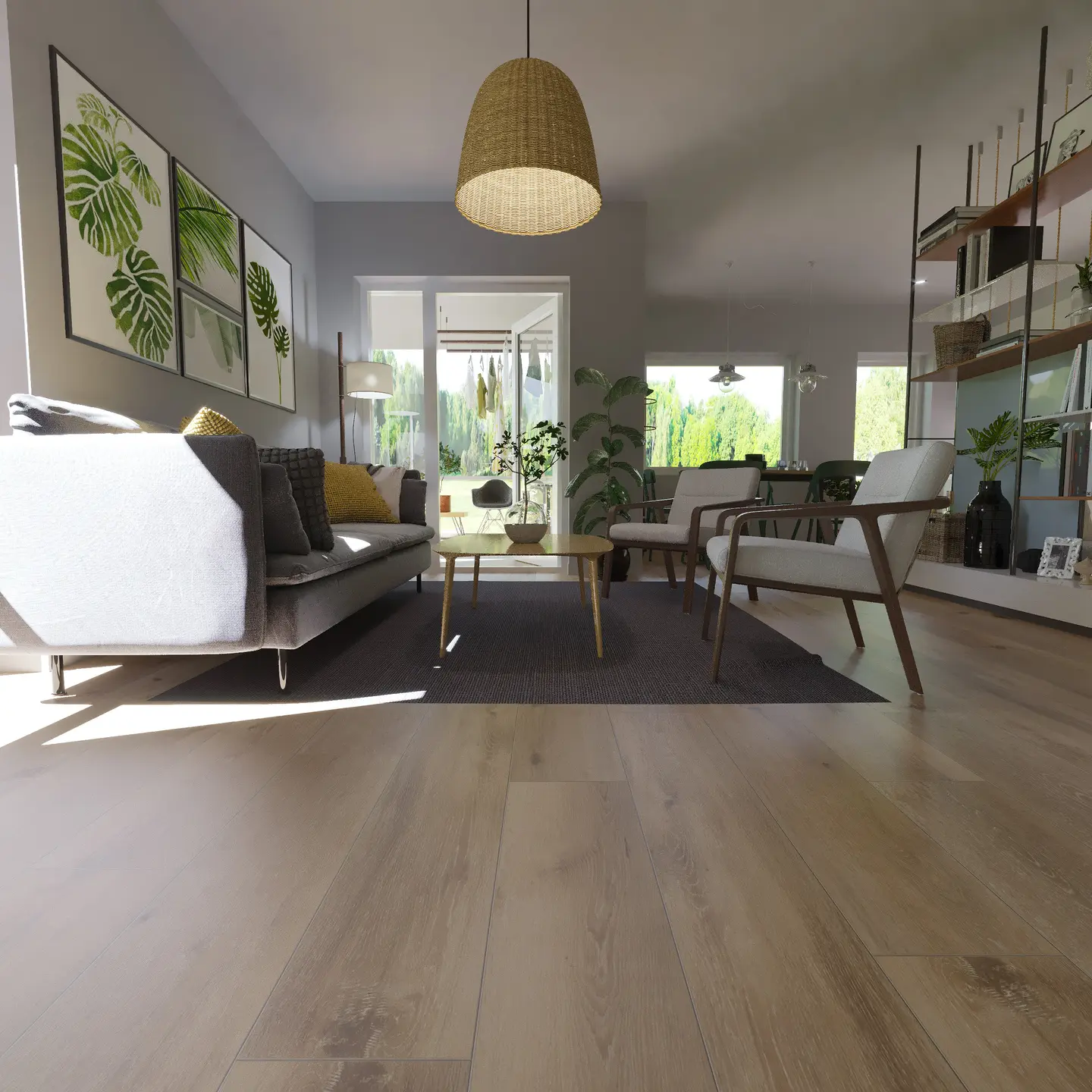
For most Orlando homeowners, waterproof LVP with a rigid SPC (Stone Polymer Composite) core is the best moisture-resistant flooring for laundry rooms. Here's why it wins across virtually every evaluation category:
Why SPC Core Matters in a Laundry Room
Not all luxury vinyl plank is created equal. SPC (Stone Polymer Composite) core planks are denser and more dimensionally stable than the older WPC (Wood Plastic Composite) format. SPC has virtually no expansion or contraction under temperature or humidity changes — critical in a space where the dryer produces heat spikes every few hours. WPC is warmer and quieter underfoot, but its slightly softer core is more vulnerable to heavy appliance feet dimpling the surface over years of use.
For a laundry room, specify:
- Rigid SPC core — for dimensional stability under appliance weight and heat
- Minimum 12mil wear layer — for laundry rooms; 20mil recommended if the space doubles as a mudroom
- Pre-attached vapor barrier underlayment — or install a separate 6-mil poly barrier over concrete
- Waterproof seam sealer applied at installation — this is the step most DIYers skip, and it is the most important upgrade in a laundry room setting
Visual Integration with Adjacent Rooms
One of LVP's major advantages for laundry rooms is design continuity. If your laundry room connects to a hallway, kitchen, or mudroom already floored in LVP, you can run the same product through — creating a seamless visual flow that makes the home feel larger and more cohesive. Browse our waterproof LVP collections to find options that match your existing flooring.
Porcelain Tile: The Ultimate Laundry Room Durability Choice
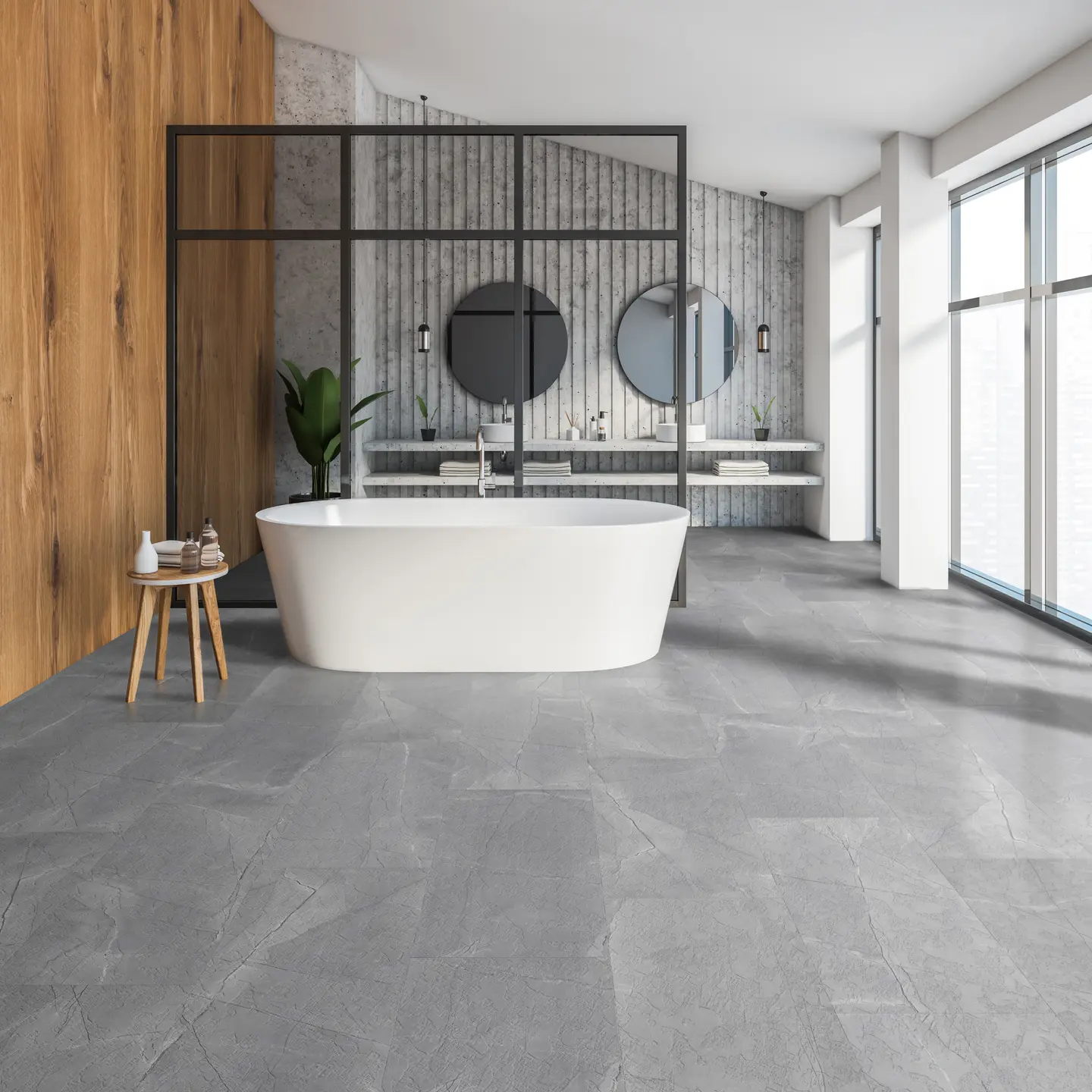
If your laundry room has flooded before — or if you have older supply hoses and want absolute peace of mind — porcelain tile is the most resilient moisture-resistant flooring for laundry rooms available. Porcelain is fired at higher temperatures than standard ceramic, making it denser, less porous, and essentially impervious to water even with prolonged exposure.
Selecting the Right Tile for a Laundry Room
Not all tile is appropriate for a laundry room floor. Specify these criteria:
- PEI Class 4 or 5 — for heavy residential floor use (lighter-rated tiles are wall or countertop products)
- COF (Coefficient of Friction) ≥ 0.6 — for slip resistance when the floor is wet from a leak or spill
- Rectified tiles — precision-cut edges allow for minimal grout joints (1/16" to 1/8"), reducing moisture entry points
- Epoxy grout — non-porous, mold-resistant, and stain-proof; standard cement grout is a liability in laundry rooms
View our porcelain tile selection and our team will help you identify the correct PEI and COF ratings for a laundry room installation.
The Tradeoffs of Tile in a Laundry Room
Porcelain tile is cold underfoot — a consideration if you spend meaningful time sorting laundry. Dropped items shatter far more readily on tile than on LVP. Tile also requires a more skilled installation: the subfloor must be perfectly flat (within 1/8" over 10 feet), the thin-set must be mixed correctly, and the grout cure time means the room is out of commission for 48 to 72 hours post-installation. For most homeowners who want a worry-free result, professional tile installation is strongly recommended rather than DIY.
Flooring to Avoid in Your Laundry Room
Several common flooring materials fail specifically in laundry room conditions, despite being marketed as "water-resistant" or "easy to clean." Here are the materials we advise strongly against at Cavalieri Flooring:
- Standard laminate flooring — even "water-resistant" laminate uses an HDF core that absorbs moisture through the seams. A single washing machine overflow can cause permanent swelling within hours. Read our waterproof laminate guide for the full technical explanation.
- Solid hardwood — expands and contracts dramatically with the humidity cycling of a laundry room. Even engineered hardwood is not recommended unless it is installed well away from the washer with excellent ventilation.
- Carpet or carpet tiles — traps lint, soap residue, and moisture. Provides an ideal growth environment for mold and mildew. Never appropriate in any wet-room adjacent space.
- Cork flooring — naturally porous and highly absorbent. Cork is excellent for bedroom or office applications but completely unsuitable near washing machines or dryers.
- Peel-and-stick vinyl tiles — the seams are wide, the adhesive fails with repeated water exposure, and the thin construction provides almost no subfloor protection. They also become extremely difficult to remove without damaging the subfloor when it's time for replacement.
Installation & Subfloor Prep in Florida
In Orlando and throughout Central Florida, subfloor preparation is the most important step in any laundry room flooring project. Florida's high water table, clay soils, and slab-on-grade construction mean that moisture rises from the ground beneath your concrete slab year-round. Failing to address this produces a scenario where even a perfectly installed waterproof floor fails from below rather than from above.
Concrete Slab Subfloor Protocol
- Moisture test first. Perform a calcium chloride test or use a Tramex meter to measure moisture emission from the slab. Acceptable levels vary by flooring manufacturer, but readings above 3 lbs/1000 sqft/24hrs require a moisture mitigation coating before any flooring is installed.
- Grind and level. The slab must be flat within 3/16" over 10 feet for LVP and 1/8" for tile. High spots are ground down; low spots are filled with floor-leveling compound and allowed to cure fully.
- Apply vapor barrier. A minimum 6-mil polyethylene sheeting or a membrane-applied vapor barrier is installed over the entire slab. Seams must overlap by 12 inches and be taped with a moisture-resistant tape. This is not optional in Florida.
- Seal seams at installation (LVP). Apply a waterproof seam sealer to every click-lock joint during installation. This converts the floor from "water-resistant individual planks" to a "fully waterproof system."
Above-Grade Wood Subfloor Protocol
If your laundry room is above a crawl space or on a second floor, the protocol changes. Wood subfloors must be inspected for soft spots, squeaks, or previous moisture damage before any new material is installed. Squeaky floors indicate loose fasteners or subfloor separation — both must be corrected. A 4-mil vapor-barrier underlayment provides sufficient protection in most above-grade installations, but always verify with your product's manufacturer specifications.
Cavalieri Flooring's Orlando Laundry Room Recommendation
At Cavalieri Flooring, we install moisture-resistant flooring for laundry rooms across Orlando and Central Florida every week. Based on our real-world installation experience in this climate, here is our standard recommendation:
For most homeowners: SPC rigid-core LVP with a 12–20mil wear layer, pre-attached moisture-barrier underlayment, and seam sealer applied during installation. This delivers 100% waterproof performance, a warm and comfortable surface, and a design that flows naturally from adjacent living spaces. Our waterproof LVP collections include options starting around $2.50/sqft that meet the SPC specification required for laundry room durability.
For homes with flooding history or high-use laundry rooms: Porcelain tile (PEI Class 4+) with rectified edges, epoxy grout, and a moisture-rated thinset over a properly leveled and vapor-sealed concrete slab. This is the most durable option available and will outlast the home's other flooring with zero maintenance concerns. Our tile installation team handles the subfloor leveling, moisture testing, and grout selection in a single project.
Visit our showroom at 4301 36th St #101, Orlando, FL 32811, call (321) 424-0546, or request a free estimate online for your laundry room project. Open Monday–Friday, 7:00 AM–5:00 PM & Saturday, 9:00 AM–3:00 PM.
Frequently Asked Questions
What is the best moisture-resistant flooring for a laundry room?
Waterproof luxury vinyl plank with a rigid SPC core is the top choice for most laundry rooms. It offers 100% waterproof construction, comfortable underfoot warmth, and wood-look aesthetics that integrate beautifully with adjacent rooms. Porcelain tile is the most durable option and tolerates flooding better than any other material, but it is colder underfoot. The best choice depends on your budget, existing style, and whether your floor has a history of flooding. Get a professional assessment to determine the right fit.
Is luxury vinyl plank truly waterproof for laundry rooms?
High-quality LVP with a rigid SPC core is 100% waterproof through the body of the plank. Where water can still penetrate is at the seams if they are not sealed during installation. In a laundry room where flooding is a real risk, always use a waterproof seam sealer and waterproof transition strips at every doorway. Professional installation with these additions makes LVP a fully moisture-proof system — not just moisture-resistant planks. Browse our waterproof LVP options.
Can I install laminate flooring in my laundry room?
Standard laminate is not recommended for laundry rooms. Even water-resistant laminate can warp and swell if standing water reaches the HDF core through the seams — and a leaking washing machine can cause permanent damage within hours. If you want a visual match to laminate in an adjacent room, use waterproof LVP in the laundry room with a precision transition strip between the two materials. Read our full waterproof laminate guide for the technical details.
What flooring should I avoid in a laundry room?
Avoid standard laminate (vulnerable to core swelling), solid hardwood (expands and warps with moisture cycling), carpet (traps mold and mildew), cork (highly absorbent), and peel-and-stick vinyl tiles (wide seams, adhesive failure). The laundry room is not the place to cut corners on waterproofing — a failed floor means subfloor replacement costs that dwarf the original flooring budget.
Do I need special underlayment for laundry room flooring?
Yes — and in Florida especially. Over concrete subfloors, use a 6-mil polyethylene vapor barrier or a membrane-applied moisture mitigation coating before your underlayment. Over wood subfloors above grade, a moisture-barrier underlayment is still recommended as insurance against washer leaks. Many premium LVP products include pre-attached underlayment with an integrated vapor barrier — verify this specification before purchasing, as it simplifies the installation and ensures continuous coverage.
Can porcelain tile crack in a laundry room from washer vibration?
Porcelain tile is extremely crack-resistant, but continuous vibration from an unbalanced washing machine can stress the grout lines over time. This is a grout maintenance issue, not a tile failure. Use epoxy grout for maximum durability and stain resistance. Setting your washer on an anti-vibration pad also significantly reduces the stress transmitted to the floor — this is a $20 upgrade that extends the life of both your floor and your machine.
Is LVP or porcelain tile better for a laundry room on a concrete slab in Florida?
Both work well on concrete slabs in Florida with proper installation. Porcelain tile offers superior hardness and is completely unaffected by flooding — preferred if your laundry room has flooded before. LVP offers warmer surface temperature, easier installation, and more forgiving performance for slow or minor leaks. For most Florida laundry rooms, LVP with a proper vapor barrier is the most practical and cost-effective choice. Tile is worth the extra cost in homes with a history of plumbing issues or where the room doubles as a utility workspace.
What is the most affordable moisture-resistant flooring for a laundry room?
Sheet vinyl remains the most affordable fully waterproof laundry room flooring option ($1–$3/sqft). Its seamless installation eliminates moisture entry points at plank seams. The tradeoff is reduced durability and difficulty replacing it if damaged. Mid-range LVP ($2–$5/sqft) offers significantly better durability, longer warranties, and the ability to replace individual planks — making it a better long-term value for most homeowners even at a higher initial price. Contact us for a free estimate on both options.
How do I stop my laundry room floor from getting moldy?
Choose a truly waterproof flooring material (LVP or tile) and install it with sealed seams and proper vapor barrier below. Ensure your dryer is properly vented to the outside — not into the room or a wall cavity. Fix any leaks immediately rather than letting moisture sit. Use epoxy grout if you have tile, as it won't absorb mold spores the way cement grout does. Maintaining indoor humidity below 60% with your air conditioning also significantly reduces mold pressure on all surfaces in the room.
Ready to Waterproof Your Laundry Room Floor?
Get a free estimate from Cavalieri Flooring for moisture-resistant flooring installation in your Orlando laundry room. We handle subfloor prep, vapor barrier, and installation in one project.
Or call us now: (321) 424-0546
Related Articles & Resources
- Is Waterproof Laminate Really Waterproof? Full Guide
- Best Flooring for Florida's Humidity
- Vinyl vs. Laminate: The Full Comparison
- Best Flooring for High-Traffic Areas
- Why Professional Installation Trumps DIY
- Shop Waterproof LVP Collections
- Shop Porcelain Tile
- LVP Installation Services in Orlando
- Tile Installation Services in Orlando
- Get a Free Waterproof Flooring Estimate
Your Laundry Room Deserves a Floor Built for Florida
Choosing moisture-resistant flooring for laundry rooms in Orlando is not just about picking a waterproof label. It requires the right core construction, a proper vapor barrier under Florida's concrete slabs, sealed seams, and professional installation that ensures every component works as a system — not just as individual products.
At Cavalieri Flooring, we handle the complete project: moisture testing, subfloor preparation, vapor barrier installation, flooring selection, and finished installation with sealed seams. You get a laundry room floor that is genuinely waterproof — not just marketed as such.
Schedule Free Laundry Room Estimate