If you are shopping for a stainless steel kitchen sink, you will probably see two numbers repeatedly: 16 gauge and 18 gauge.
At first, choosing between them sounds simple. A lower gauge number means thicker stainless steel, so 16 gauge must automatically be better—right?
Not quite.
A 16-gauge stainless steel sink is thicker and generally more rigid than an otherwise comparable 18-gauge sink, making it an excellent choice for large bowls, workstation sinks, frequent cooking, and kitchens where heavy cookware is used regularly. But a well-made 18-gauge 304 stainless steel sink can also be an excellent residential kitchen sink.
In fact, sink quality depends on much more than gauge alone. The stainless steel grade, manufacturing quality, sound-deadening system, bowl shape, finish, mounting method, drain placement, cabinet size, and overall construction can affect your everyday experience just as much—or more.
If you are deciding between a 16-gauge vs. 18-gauge stainless steel sink, this guide explains what the numbers really mean and how to choose the right sink for your kitchen.
Key takeaway
For most homeowners, both 16-gauge and 18-gauge stainless steel are good choices. Gauge matters, but the best sink also has the right steel grade, bowl design, sound treatment, dimensions, mounting method, and support.
Quick Answer: Is 16 Gauge or 18 Gauge Better for a Kitchen Sink?
For most homeowners, both 16-gauge and 18-gauge stainless steel are good choices.
Choose 16 gauge when you want a thicker, more rigid sink, especially for:
- Busy family kitchens
- Large single-bowl sinks
- Workstation sinks
- Heavy pots and cast-iron cookware
- Frequent cooking
- Premium kitchen renovations
- Heavy residential or commercial-type use
Choose 18 gauge when you want:
- Strong everyday residential performance
- A more affordable stainless steel sink
- A smaller or moderately sized bowl
- A quality undermount sink without paying extra solely for thickness
- A sink with good sound-deadening pads and undercoating
- Excellent value for a normal household kitchen
The mistake is assuming that every 16-gauge sink is better than every 18-gauge sink. A poorly manufactured 16-gauge sink can still be inferior to a properly engineered 18-gauge sink.
Consumer Reports found in its testing of stainless steel sinks that gauge had relatively little effect on overall performance and that exterior sound-absorbing pads were particularly important for reducing noise.
16 Gauge vs. 18 Gauge Stainless Steel Sink Comparison
| Feature | 16-Gauge Stainless Steel | 18-Gauge Stainless Steel |
|---|---|---|
| Steel thickness | Thicker | Slightly thinner |
| Nominal thickness* | About 0.0625 in. / 1.59 mm | About 0.050 in. / 1.27 mm |
| Rigidity | Excellent | Very good |
| Resistance to flexing | Higher | Slightly lower |
| Dent resistance | Generally better | Good for normal residential use |
| Sink weight | Heavier | Lighter |
| Typical price | Usually higher | Usually more affordable |
| Residential kitchens | Excellent | Excellent |
| Busy family kitchens | Excellent | Very good to excellent |
| Large workstation sinks | Excellent | Depends on construction |
| Undermount installation | Excellent | Excellent |
| Noise | Can help reduce vibration, but padding matters greatly | Can be quiet with quality pads and coating |
| Best value | Premium/heavy use | Most everyday kitchens |
*Gauge dimensions are nominal and can vary by manufacturer. The Specialty Steel Industry of North America notes that stainless steel gauge thicknesses are not defined by ASTM and recommends specifying actual thickness when precision matters.
What Does Gauge Mean on a Stainless Steel Sink?
Gauge describes the thickness of the stainless steel sheet used to manufacture the sink.
One confusing part is that the numbering works backward:
Lower gauge number = thicker metal.
Therefore:
- 16 gauge is thicker than 18 gauge
- 18 gauge is thicker than 20 gauge
- 20 gauge is thicker than 22 gauge
Nominal thickness at a glance
Lower gauge number = thicker stainless steel.
Illustrative comparison based on nominal values — actual thickness can vary by manufacturer and is not shown as a measurement of a particular sink.
A commonly referenced stainless steel gauge chart lists:
| Gauge | Nominal thickness | Millimeters |
|---|---|---|
| 16 gauge | 0.0625 in. | 1.587 mm |
| 18 gauge | 0.0500 in. | 1.270 mm |
| 20 gauge | 0.0375 in. | 0.953 mm |
| 22 gauge | 0.03125 in. | 0.794 mm |
Using those nominal measurements, 16-gauge stainless steel is approximately 25% thicker than 18-gauge stainless steel.
However, those numbers should be treated as nominal references rather than a guarantee of the exact thickness of every sink. Industry guidance notes that actual stainless steel thickness associated with a gauge designation can vary by producer and manufacturing tolerance.
Is 16 Gauge Really Better Than 18 Gauge?
16 gauge is thicker, but “thicker” and “better” are not always identical.
If two sinks were otherwise identical—the same stainless steel grade, shape, manufacturing process, finish, dimensions, sound treatment, and design—the thicker 16-gauge version would generally offer greater rigidity.
That can be valuable in a large kitchen sink.
But real sinks are rarely identical.
Two sinks with the same gauge can perform differently because of differences in:
- Stainless steel grade
- Bowl geometry
- Forming process
- Weld quality
- Reinforcement
- Sound-deadening pads
- Undercoating
- Corner radius
- Sink depth
- Drain location
- Finish
- Installation quality
This is why gauge should be one specification you compare, not the only specification.
Major sink manufacturers currently offer both 16- and 18-gauge stainless steel products. Kraus, for example, markets both heavy-duty 16-gauge models and 18-gauge collections for residential kitchens.
Does 16 Gauge Dent Less Than 18 Gauge?
Generally, a thicker 16-gauge sink should be more resistant to deformation and flexing than a comparable 18-gauge sink.
This can matter when you frequently handle:
- Cast-iron skillets
- Dutch ovens
- Large stock pots
- Heavy baking sheets
- Oversized cookware
The difference can become more relevant as the sink gets larger because a wide, unsupported surface has more opportunity to flex.
For a smaller prep sink or a normal residential bowl, however, a properly manufactured 18-gauge sink may already provide all the rigidity the homeowner needs.
Kraus, for example, currently describes both its 16-gauge and 18-gauge stainless steel models as suitable for durable kitchen use.
What about scratches?
Do not confuse dent resistance with scratch resistance.
A thicker sheet of stainless steel does not automatically prevent surface scratches.
Scratch visibility is also affected by:
- Surface finish
- Grain direction
- Cleaning technique
- Cookware
- Sink grids
- Abrasive cleaners
A satin or brushed finish can help ordinary wear blend into the existing grain more naturally than a highly polished surface. Consumer Reports similarly found that matte or grain finishes tended to conceal scratches and stains better than glossy finishes.
Is a 16-Gauge Sink Quieter Than an 18-Gauge Sink?
This is one of the most misunderstood parts of the 16-gauge vs. 18-gauge comparison.
A thicker sink can have greater mass and rigidity, which may help reduce certain vibrations. But gauge is not the only—or necessarily the most important—factor determining sink noise.
Look underneath a good stainless steel sink. You may find:
- Sound-deadening pads
- Rubber or composite insulation
- Protective undercoating
- Pads along the bowl walls
- Additional coating underneath the basin
These materials help dampen vibration caused by running water, dishes, garbage disposals, and cookware.
Consumer Reports tested stainless steel sinks and found that sound-absorbing pads on the outside of the sink were more effective at quieting running-water noise than relying simply on heavier steel or spray coating.
So when comparing two sinks, do not ask only:
“Is this 16 gauge or 18 gauge?”
Also ask:
“What sound-deadening system is underneath it?”
That question can be just as important.
Does 16 Gauge Resist Rust Better Than 18 Gauge?
Not inherently.
This is another important distinction that is often oversimplified in sink comparisons.
Gauge tells you primarily about thickness.
Corrosion resistance depends heavily on factors such as:
- Stainless steel grade
- Chromium content
- Nickel content
- Surface condition
- Manufacturing quality
- Chloride exposure
- Cleaning products
- Contamination from other metals
The Specialty Steel Industry of North America explains that stainless steel's corrosion resistance comes from its chromium-rich passive surface layer. It also notes that alloy composition changes corrosion resistance; for example, Type 316 includes molybdenum that improves resistance in chloride environments.
Therefore, you should not automatically assume that a 16-gauge sink is more corrosion resistant simply because it is thicker.
Steel grade matters.
What Is 304 Stainless Steel, and Why Does It Matter?
When shopping for a stainless steel kitchen sink, you may see products advertised as 304 stainless steel, T-304 stainless steel, 18/8 stainless, or 18/10 stainless.
Type 304 belongs to the austenitic 300-series stainless steels and is widely used for kitchen applications.
According to the Specialty Steel Industry of North America, Type 304 contains approximately:
- 18–20% chromium
- 8–10.5% nickel
Chromium helps form stainless steel's protective passive surface layer, while the alloy as a whole provides the combination of corrosion resistance, formability, durability, and appearance that makes 304 common in kitchen environments.
Don't confuse 18/10 with 18 gauge
This causes a tremendous amount of confusion.
18 gauge = thickness.
18/10 = a shorthand often used to describe approximately 18% chromium and 10% nickel.
They are completely different specifications.
An 18-gauge sink can be made from 304 stainless steel, and a 16-gauge sink can also be made from 304 stainless steel.
Gauge tells you how thick it is. Grade tells you what stainless alloy it is made from.
304 Stainless Steel vs. 16 Gauge: Which Specification Matters More?
You should not choose between them because they describe different characteristics.
Ideally, evaluate both.
For example:
16-gauge 304 stainless steel tells you that the sink combines thicker construction with a commonly used corrosion-resistant stainless steel grade.
Meanwhile, 18-gauge 304 stainless steel means the sink uses slightly thinner material but retains the properties associated with the 304 alloy.
For many homeowners, a well-constructed 18-gauge 304 sink offers an excellent combination of durability and value.
For someone wanting greater rigidity in a large, premium, or heavily used sink, 16-gauge 304 stainless becomes particularly attractive.
Is 18 Gauge Too Thin for a Kitchen Sink?
No.
Quality 18-gauge stainless steel sinks are widely sold for residential kitchens.
An 18-gauge sink can make sense for:
- Everyday family kitchens
- Condos
- Apartments
- Rental properties
- Bar and prep areas
- Smaller sinks
- Moderate cooking
- Budget-conscious kitchen renovations
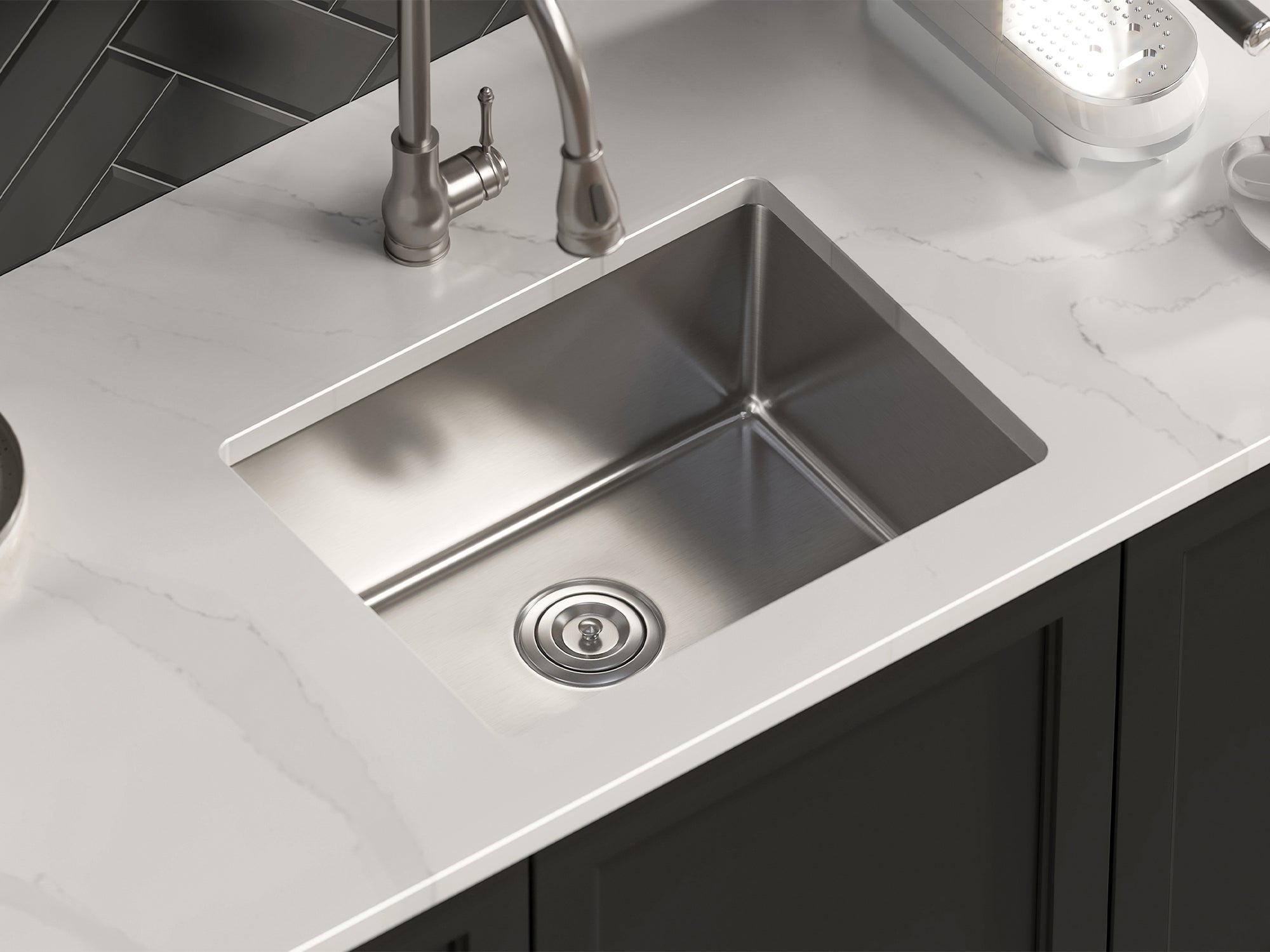
The Pelican Urban Series PL-VR2318 sold by Cavalieri Flooring uses 18-gauge 304 Series stainless steel along with Pelican Protect Coating and sound-deadening pads.
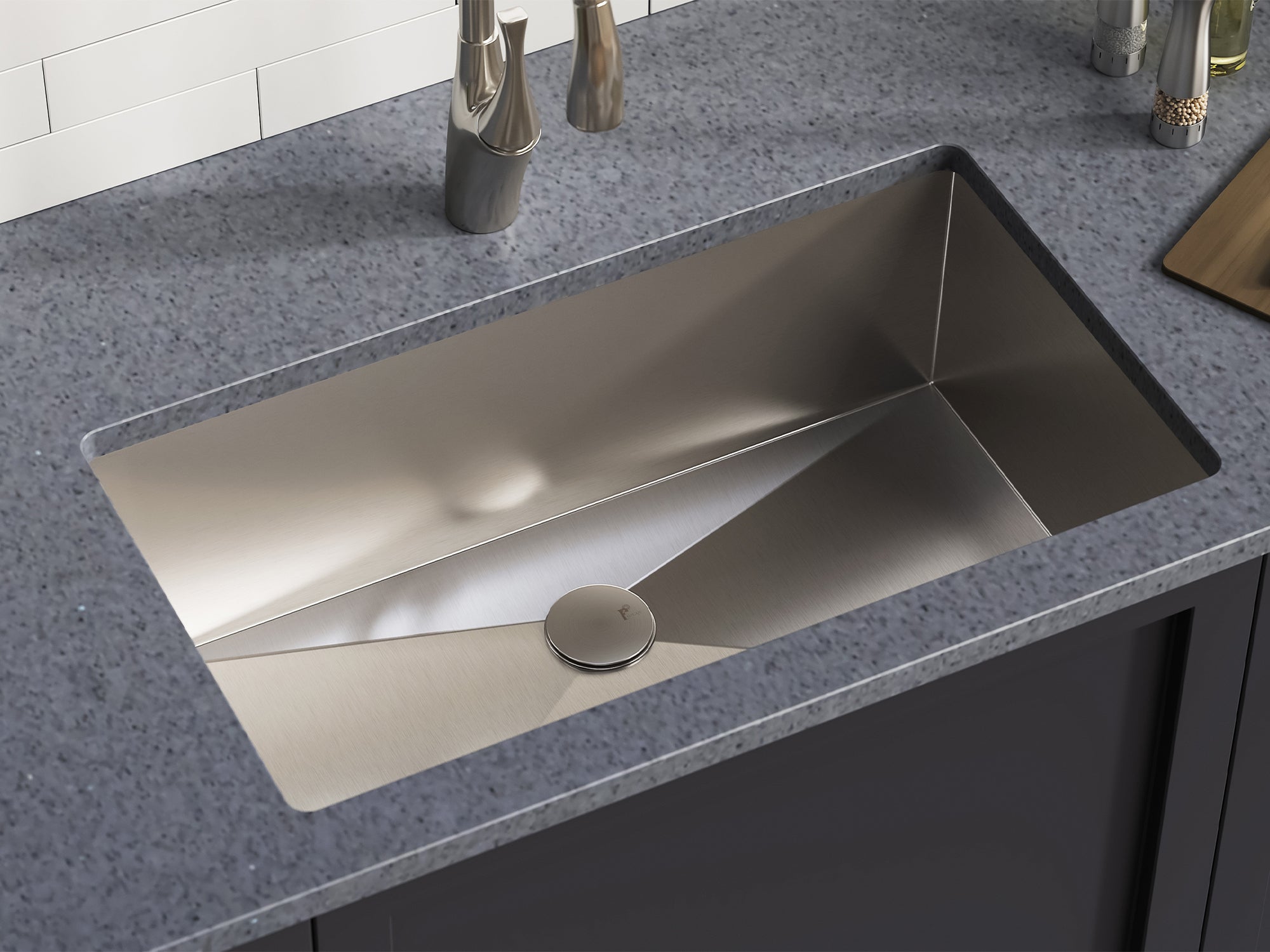
The larger PL-VR2718 similarly uses heavy-duty 18-gauge 304 Series stainless steel with sound-deadening treatment.
That combination demonstrates why evaluating the entire sink construction is more useful than judging a product from gauge alone.
When Is a 16-Gauge Stainless Steel Sink Worth It?
Paying more for 16 gauge makes the most sense when the additional rigidity has practical value.
Consider 16 gauge if you:
- Cook almost every day
- Frequently use heavy cast-iron cookware
- Want a large single-bowl sink
- Are buying a workstation sink
- Want a premium kitchen renovation
- Prefer a heavier and more substantial-feeling bowl
- Use a high-powered garbage disposal
- Expect unusually heavy kitchen use
- Want maximum rigidity
- Are buying for a demanding residential or commercial-style application
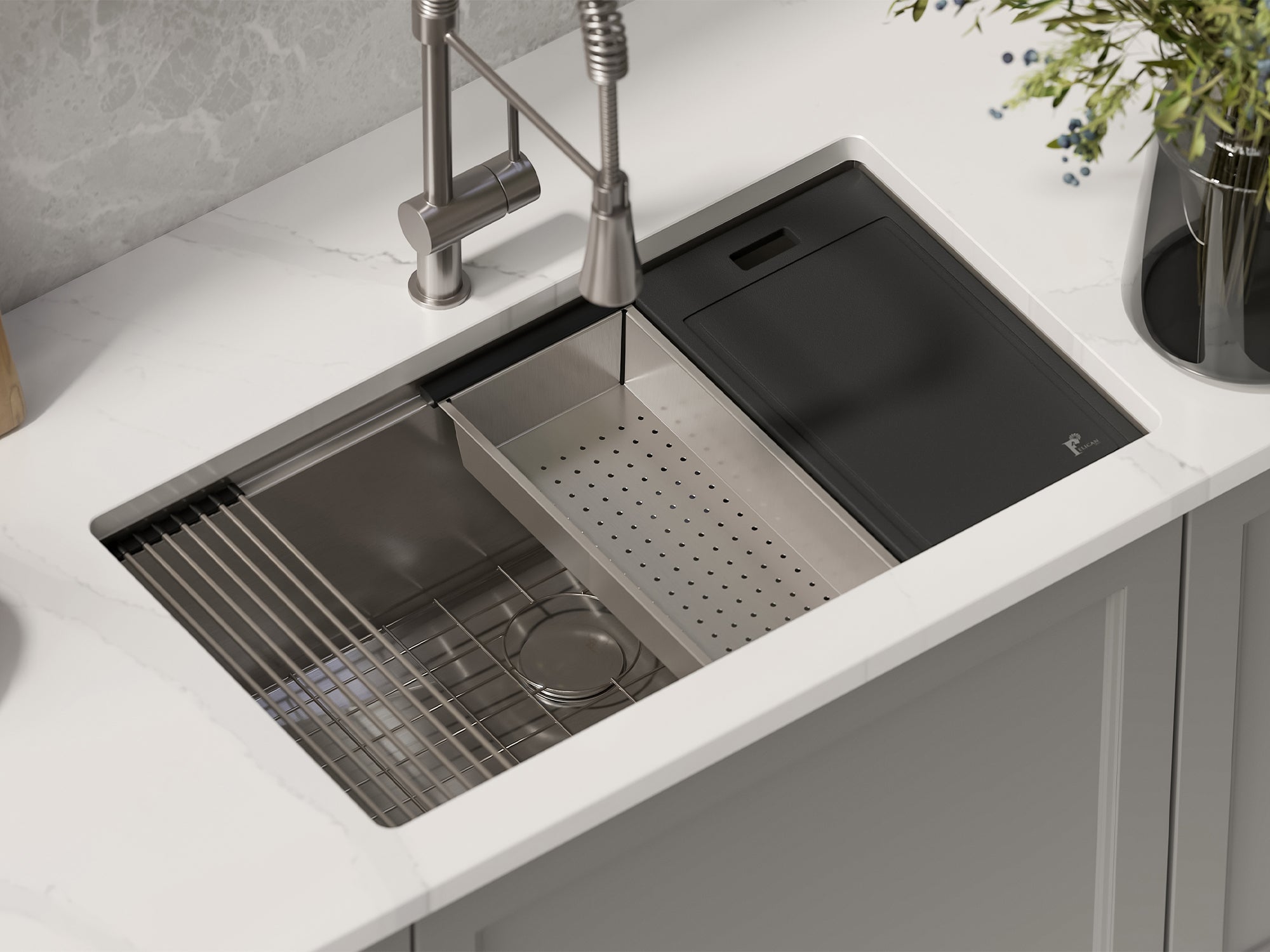
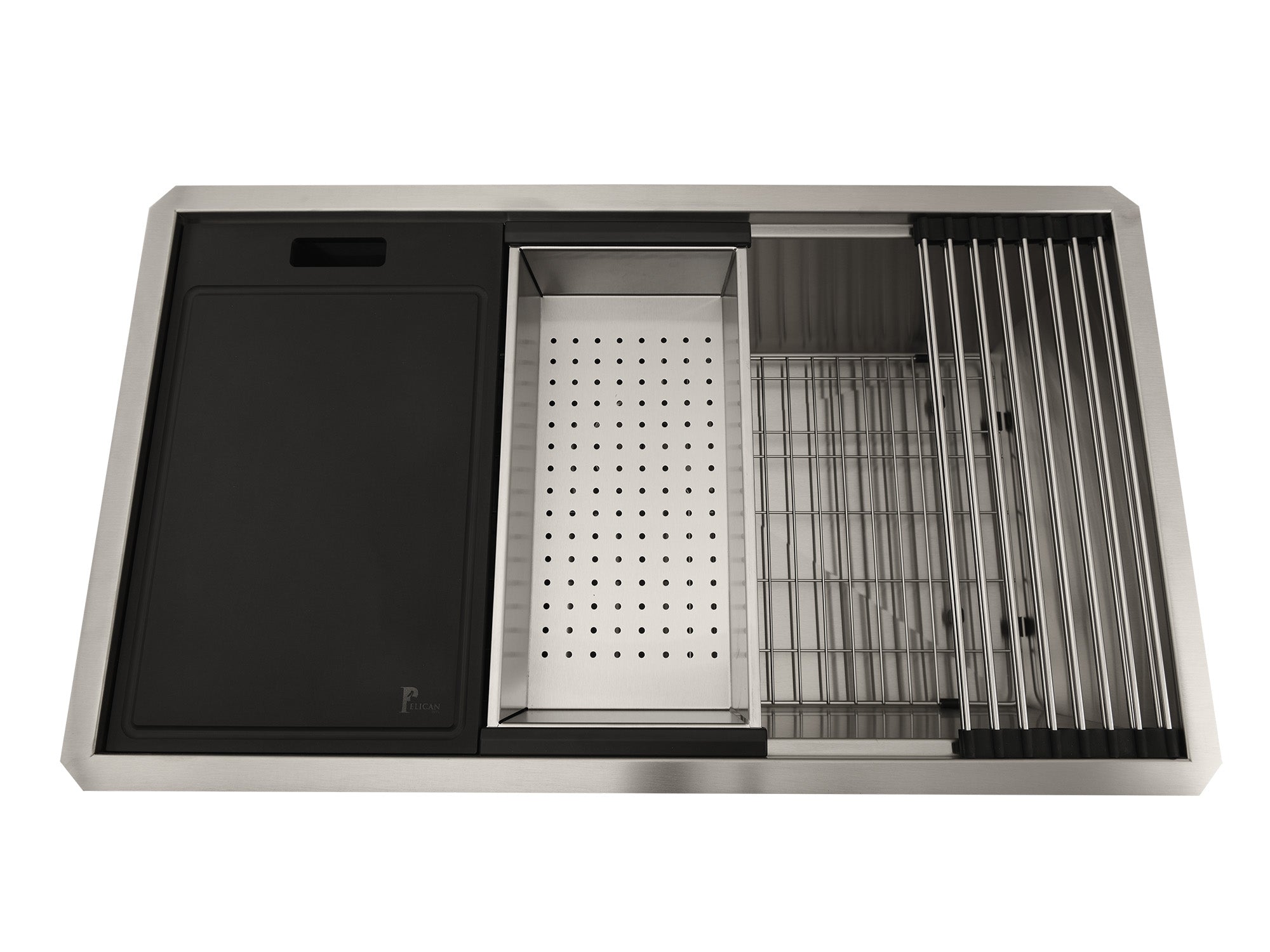
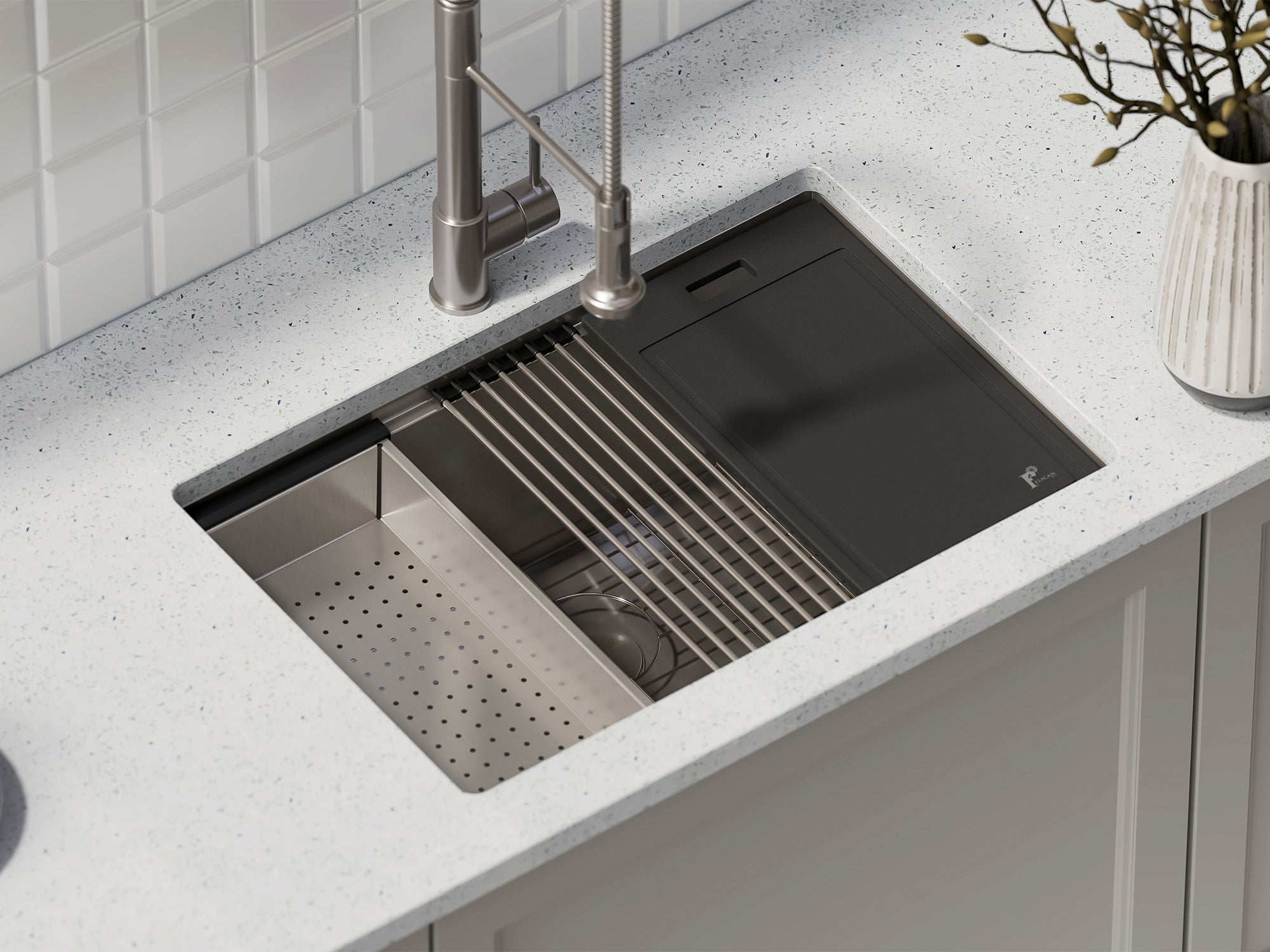
Cavalieri Flooring's PL-WS3319 workstation sink, for example, is manufactured from 16-gauge 304 Series stainless steel and includes sound-deadening pads and protective coating. It also incorporates workstation accessories such as a cutting board, colander, folding rack, bottom grid, and drain components.
A large workstation is exactly the type of sink where heavier construction makes practical sense because the bowl is spacious and designed for frequent food preparation.
When Is an 18-Gauge Sink the Better Value?
Choose a quality 18-gauge sink when you want durability but do not necessarily need the heaviest construction available.
It can be an excellent choice for:
Normal family kitchens
If you cook regularly but do not subject the sink to unusually heavy abuse, 18 gauge can provide years of useful service when the product is well constructed.
Rental properties
An 18-gauge 304 stainless steel sink can offer an attractive balance between price, durability, cleanability, and replacement cost.
Smaller kitchens
A compact sink generally does not require the same rigidity consideration as a very large workstation bowl.
Secondary sinks
Bar sinks, prep sinks, laundry sinks, and secondary kitchen sinks may not benefit enough from the additional thickness to justify a higher cost.
Budget-focused remodeling
If the choice is between spending extra money solely on gauge or selecting a better-designed sink with effective sound pads, useful bowl dimensions, proper drain position, and quality construction, the overall design may deliver more day-to-day value.
16 Gauge vs. 18 Gauge for Undermount Sinks
Both 16- and 18-gauge stainless steel can work well for undermount kitchen sinks.
With an undermount installation, the sink attaches beneath the countertop, creating a clean transition from countertop to bowl.
Benefits include:
- Clean appearance
- Easy countertop cleanup
- No raised rim around the countertop
- Modern design
- More continuous-looking countertop space
Gauge does not determine whether a sink can be undermounted. The sink must be specifically designed for the mounting method and installed according to its requirements.
Proper sink support is particularly important with:
- Large bowls
- Heavy sinks
- Garbage disposals
- Stone countertops
- Workstation sinks
A thick sink should never be treated as a substitute for proper installation.
16 Gauge vs. 18 Gauge for Workstation Sinks
If you are buying a large workstation sink, 16 gauge becomes particularly compelling.
A workstation sink may support accessories over the bowl, such as:
- Cutting boards
- Colanders
- Drying racks
- Sink grids
- Prep trays
Because these sinks are often wide and designed to become an active food-preparation area, additional rigidity can be valuable.
Cavalieri Flooring's Pelican PL-WS3319 and PL-WS2819 workstation models are both built from 16-gauge 304 Series stainless steel.
For homeowners building a high-use kitchen, a 16-gauge workstation sink is therefore one of the situations where upgrading thickness makes particularly good sense.
16 Gauge vs. 18 Gauge for Farmhouse Sinks
Farmhouse and apron-front sinks tend to be larger and more visually prominent than standard sinks.
For a stainless steel farmhouse sink, consider:
- Overall width
- Bowl depth
- Cabinet modification requirements
- Sink weight
- Countertop support
- Apron design
- Stainless steel grade
- Sound treatment
- Gauge
Because farmhouse sinks can have large exposed surfaces, heavier construction may provide a more substantial feel.
However, once again, gauge alone should not determine the purchase.
A well-designed farmhouse sink must also fit the cabinet correctly and be adequately supported.
What About 20-Gauge or 22-Gauge Stainless Steel Sinks?
As the gauge number increases, the stainless sheet generally becomes thinner.
Typical nominal references are approximately:
- 16 gauge: 0.0625 inch
- 18 gauge: 0.050 inch
- 20 gauge: 0.0375 inch
- 22 gauge: 0.03125 inch
Actual thickness varies by manufacturer and tolerance.
A 20- or 22-gauge sink may work for lighter-duty applications, but for a primary kitchen sink we generally recommend evaluating 16- and 18-gauge products first when those options fit the project's budget and design.
Thinner steel may become more noticeable in:
- Large bowls
- Heavy-use kitchens
- Sinks with inadequate sound treatment
- Installations with garbage disposals
- Areas subject to heavy cookware impact
Does a Garbage Disposal Require a 16-Gauge Sink?
Not necessarily.
Both appropriately constructed 16- and 18-gauge stainless steel sinks can be compatible with garbage disposals.
However, a garbage disposal introduces:
- Additional weight
- Motor vibration
- Movement beneath the drain
- Repeated mechanical operation
A heavier sink can feel more rigid, but proper mounting, disposal installation, sink support, sound pads, and construction quality are also important.
Always verify that the specific sink accepts the disposal system you plan to install.
Does Sink Thickness Affect Water Spots?
No meaningful direct relationship exists between gauge and ordinary water spotting.
Water spots are affected more by:
- Mineral content in the water
- Whether water is allowed to evaporate on the surface
- Finish
- Cleaning routine
Orlando and other Central Florida homes can have mineral-rich water, so regular rinsing and drying can help a stainless steel sink maintain its appearance.
A brushed or satin finish also tends to make everyday wear less noticeable than a mirror-like polished finish.
Does Stainless Steel Sink Gauge Affect Heat Resistance?
Stainless steel is generally well suited to kitchen environments where hot cookware, boiling water, and food preparation are common.
However, simply selecting 16 gauge instead of 18 gauge should not be interpreted as giving the sink unlimited resistance to heat damage.
Always follow the sink manufacturer's care instructions.
Avoid judging heat performance based entirely on gauge because alloy, manufacturing, finish, insulation, and surrounding countertop materials also matter.
What Else Should You Look for Besides Gauge?
This may be the most important section of this entire guide.
When comparing stainless steel sinks, consider all of these specifications.
1. Stainless steel grade
Look for a clearly identified alloy such as 304 stainless steel instead of relying only on vague wording like “premium stainless.”
2. Sound-deadening pads
Inspect how much of the underside is actually treated.
Large pads along the bowl and sidewalls can reduce vibration significantly.
3. Protective undercoating
Quality undercoating can contribute to sound control and may help reduce condensation underneath the sink.
4. Bowl depth
A deeper bowl makes it easier to handle large pots but also lowers the working surface.
Common kitchen sink depths are often around 8–10 inches, although designs vary.
5. Inside corner radius
Sink corners can range from sharp zero-radius designs to softer rounded corners.
Tighter corners:
- Modern appearance
- Maximum usable bottom area
- Require more attention when cleaning
Rounded corners:
- Easier to wipe clean
- Softer appearance
- Often easier for everyday maintenance
6. Drain location
Rear or offset drains may preserve usable cabinet space beneath the sink and can change how dishes sit in the bowl.
7. Bowl configuration
Choose among:
- Single bowl
- 50/50 double bowl
- 60/40 double bowl
- Workstation bowl
- Prep sink
The best design depends on how you actually use your kitchen.
8. Cabinet size
Do not buy a sink based only on the sink's listed width.
Check the manufacturer's minimum base cabinet requirement.
9. Included accessories
Some sinks include:
- Bottom grids
- Cutting boards
- Colanders
- Roll-up drying racks
- Basket strainers
- Drain covers
A higher-priced sink that includes useful accessories can sometimes provide better overall value.
10. Warranty
Review what the warranty actually covers rather than assuming “lifetime warranty” covers every form of damage.
16-Gauge vs. 18-Gauge Stainless Steel Sink: Which One Should You Buy?
Here is the simplest way to decide.
Choose a 16-gauge stainless steel sink if:
- You want maximum rigidity
- You use heavy cookware frequently
- Your sink will see intensive daily use
- You want a large workstation sink
- The price difference is modest
- You are building a premium kitchen
- You prefer heavier construction
Choose an 18-gauge stainless steel sink if:
- You want excellent everyday durability at a lower cost
- Your kitchen receives normal residential use
- You are buying a smaller or moderately sized bowl
- The sink has good sound-deadening pads
- The sink uses quality 304 stainless steel
- You would rather spend your budget on size, accessories, faucet, or other kitchen upgrades
Our recommendation
For most homeowners, 18-gauge 304 stainless steel is not a compromise-quality material. A properly manufactured 18-gauge sink is a strong residential choice.
However, when the sink is large, heavily used, or designed as a workstation, 16-gauge 304 stainless steel is an upgrade worth considering.
Instead of asking:
“Which gauge is best?”
Ask:
“Which complete sink is best for how I use my kitchen?”
That leads to a much better purchase.
Real-World Examples: Comparing Stainless Steel Sink Options
Cavalieri Flooring carries stainless steel sinks with different constructions so customers can choose based on the actual application rather than buying solely by gauge.
Pelican PL-VR2318 — 18 Gauge
The PL-VR2318 is a 23-inch Urban Series sink made from 18-gauge 304 Series stainless steel. It uses a satin-brushed finish, low-radius corners, Pelican Protect Coating, and sound-deadening pads.
Good fit for: Smaller kitchens, prep areas, condos, and homeowners wanting a durable stainless steel sink at an accessible price.
Pelican PL-VR2718 — 18 Gauge
The PL-VR2718 is a 27-inch Urban Series sink using 18-gauge 304 Series stainless steel, sound-deadening pads, protective coating, and a satin-brushed finish.
Good fit for: Everyday residential kitchens where buyers want a quality undermount stainless steel sink without necessarily requiring 16-gauge construction.
Pelican PL-HA115 — 16- or 18-Gauge Handmade Series
The Handmade PL-HA115 is listed as available in 16- or 18-gauge 304 Series stainless steel, allowing the buyer to choose construction according to the project. It also incorporates sound-deadening pads and Pelican Protect Coating.
Good fit for: Premium kitchen renovations and buyers who want a handmade bowl with deeper construction and modern geometry.
Pelican PL-WS3319 — 16-Gauge Workstation
The 33-inch PL-WS3319 workstation uses 16-gauge 304 Series stainless steel and incorporates a complete workstation ledge system with included accessories.
Good fit for: Serious home cooks, large kitchens, meal preparation, heavy everyday use, and homeowners who want the sink itself to become part of the workspace.
Frequently Asked Questions About Stainless Steel Sink Gauge
What is the best gauge for a stainless steel kitchen sink?
For a primary residential kitchen, 16 and 18 gauge are both strong choices. Choose 16 gauge when greater rigidity is important and 18 gauge when you want a strong balance between durability and value.
Is 16 gauge thicker than 18 gauge?
Yes. Gauge numbers work backward. A commonly used nominal stainless steel gauge chart lists 16 gauge around 0.0625 inch and 18 gauge around 0.050 inch. Actual manufactured thickness can vary.
How much thicker is 16 gauge than 18 gauge?
Using common nominal stainless steel gauge values, 16 gauge is approximately 25% thicker than 18 gauge.
Is 18 gauge good enough for a kitchen sink?
Yes. A well-made 18-gauge 304 stainless steel sink with proper sound-deadening and quality construction can be an excellent choice for normal residential kitchen use.
Is 16 gauge worth the extra money?
It can be. The upgrade makes the most sense for large sinks, workstation sinks, heavy cookware, intensive use, and buyers who value additional rigidity. For a normal kitchen, a quality 18-gauge model may offer better value.
Which is quieter: 16 gauge or 18 gauge?
A thicker sink may transmit vibration differently, but sound pads and overall construction are extremely important. Consumer Reports found sound-absorbing exterior pads played an important role in quieting stainless steel sinks.
Does 16 gauge resist rust better?
Not automatically. Gauge refers primarily to thickness. Corrosion resistance is strongly influenced by the stainless steel alloy, chemistry, surface condition, environment, and maintenance.
Is 304 stainless steel good for kitchen sinks?
Yes. Type 304 is a commonly used austenitic stainless steel containing chromium and nickel. SSINA lists its typical chemistry at approximately 18–20% chromium and 8–10.5% nickel.
Is 18/10 the same thing as 18 gauge?
No. 18 gauge describes thickness, while 18/10 refers to an approximate chromium/nickel composition designation commonly associated with certain austenitic stainless steels. They should not be confused.
Is a lower sink gauge better?
A lower gauge means thicker steel, which can provide additional rigidity. However, a lower number does not automatically guarantee better overall quality. Steel grade, design, sound treatment, manufacturing and installation still matter.
What gauge should I choose for a workstation sink?
For a large, heavily used workstation sink, 16 gauge is an excellent choice because the increased thickness can provide additional rigidity across the larger bowl.
What gauge stainless steel sink is best for a rental property?
A quality 18-gauge 304 stainless steel sink can be an excellent balance of durability, appearance and replacement cost for rental properties.
Should I choose 16 gauge or 18 gauge for an undermount sink?
Either can work. Choose based on bowl size, usage, overall construction, sound treatment, countertop compatibility and budget rather than mounting style alone.
Sources & References
- Consumer Reports — Selecting your sink and faucet for sink testing, gauge comparisons, finish behavior, and sound-absorbing pad findings.
- Specialty Steel Industry of North America — Technical Resources for stainless steel gauge conventions, passive-film context, and Type 304 chemistry.
Shop Stainless Steel Kitchen Sinks
Choosing between 16 gauge and 18 gauge becomes much easier when you compare the complete sink, not just one number on the specification sheet.
At Cavalieri Flooring, you can compare stainless steel kitchen sinks in multiple sizes, bowl configurations and construction styles, including:
- 16-gauge stainless steel sinks
- 18-gauge stainless steel sinks
- 304 stainless steel sinks
- Undermount kitchen sinks
- Single-bowl sinks
- Double-bowl sinks
- Handmade stainless steel sinks
- Workstation sinks
- Farmhouse sinks
- Sink accessories
- Kitchen faucets
When comparing models, consider gauge + steel grade + sound protection + bowl dimensions + mounting style + accessories together.
That is a much better way to find a sink that fits your kitchen than choosing based on thickness alone.
As you complete your kitchen setup, see our guide on how to choose the right kitchen faucet and compare pull-down vs. pull-out kitchen faucets before making a final selection.